
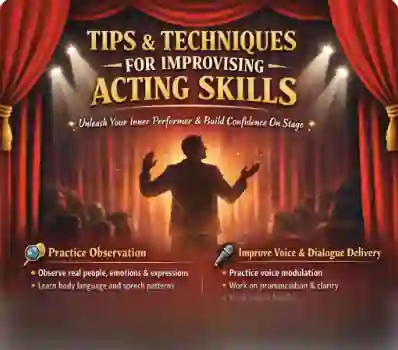
Tips and Techniques for Improvising Acting Skills
A Comprehensive Guide for Actors — Beginners to Pros
Acting is both an art and a craft. It requires technique, emotional depth, presence, and — most importantly — the ability to adapt in real time. One of the most valuable tools in an actor’s toolkit is improvisation. Whether you’re preparing for an audition, rehearsing for a play, performing in a film, or simply striving to become more confident on stage, improvisation skills make you more spontaneous, authentic, bold, and creatively ready.
In this extensive guide, we’ll explore what improvisation truly means, why it matters, and practical tips and techniques to sharpen your imbalance-breaking, scene-saving, high-impact acting skills. We’ll also share how professional training — for example at institutions like MS Asian Film Academy (www.msasianfilmacademy.com) — can accelerate your growth and deepen your performance craft.
What is Improvisation in Acting?
Improvisation — often called improv — is the art of creating performance spontaneously, without a script. It’s storytelling in the moment, fueled by imagination, intuition, and emotional responsiveness.
At its core, improvisation is:
✔ Responding authentically to what is happening right now
✔ Accepting and building on offers from partners (the “Yes, And…” principle)
✔ Exploring character, environment, conflict, and action without planning ahead
✔ Staying grounded in truth and connection
Unlike scripted acting, where you follow written dialogue and actions, improv builds your instincts and strengthens your ability to react in life-like ways.
Why Improvisation Skills Matter for Every Actor
Even in strictly scripted roles, improvisation is foundational. It trains the actor to:
1. Listen Deeply
Listening is more than hearing lines — it’s absorbing your scene partner’s emotions, rhythm, intentions, and subtext.
2. Stay Present
Improv trains you to drop performance autopilot and truly engage in the moment.
3. Embrace Risk
The spontaneous nature of improv pushes you beyond comfort zones, encouraging bold choices.
4. Build Collaborative Awareness
You learn to support your scene partner and co-create emotionally truthful performance.
5. Enhance Creativity
Improvisation expands your imagination, making your acting richer and more dynamic.
Foundational Improvisation Techniques for Actors
Here are essential techniques you can practice alone, with a partner, or in group workshops like those available at MS Asian Film Academy:
1. The “Yes, And…” Principle
One of the most famous rules in improv — and for good reason.
✔ “Yes” means accepting everything your partner gives you
✔ “And…” means you add something of your own
This keeps scenes alive, truthful, and forward-moving.
Example:
Partner: “Wow, I can’t believe we’re lost in space!”
You: “Yes, and I think the oxygen’s running low — but I found something glowing over there!”
Why it’s powerful:
It dismantles rejection and judgement, turning scenes into cooperative storytelling.
2. Emotional Memory Exploration
Tap into personal emotional experiences to bring realism into your scenes.
Exercise:
- Think of a memory that made you deeply happy, sad, or anxious
- Inhale the emotion
- Let it color your voice and body language
This isn’t about dumping your emotions — it’s about accessing emotional truth safely and channeling it into performance.
3. Physical Improvisation
Acting is not just verbal — it’s movement, gesture, stance, and physical energy.
Try this exercise:
- Move around the room without speaking
- React to imaginary objects: is the floor lava? Are you walking through sand?
- Let your body tell the story
Physical impulse often unlocks deeper emotional layers.
4. Character Hot-Seating
Sit in the “hot seat” as your character — and answer personal questions:
- What do you want most?
- What scares you?
- What is your earliest memory?
Character motivation becomes clearer, enriching your choices in improv scenes.
5. Word-at-a-Time Storytelling
Partners build a story together — each person adds one word at a time.
This develops:
✔ Listening
✔ Timing
✔ Trust
✔ Cohesion
It’s a simple and fun way to strengthen ensemble skills.
6. Prop Transformation
Take any ordinary object — a hat, a cup, a stick — and transform it.
Examples:
- A sword
- A microphone
- A magic wand
This sharpens imagination and helps you create meaning beyond the literal.
7. Emotional Transportation
Jump from one emotional state to another instantly.
Practice scenes where someone says:
“I’m ecstatic!”
“…and now I’m heartbroken.”
This trains emotional flexibility and honest reaction.
8. Status Work
Status refers to the power dynamic between characters.
Try playing the same scene with changing statuses:
- High status → Low status
- Low → High
- Equal status
You’ll discover how power shapes your choices in dialogue and presence.
9. Silent Improv
No speaking — just actions and reactions.
This sharpens:
✔ Body awareness
✔ Non-verbal communication
✔ Subtle response
Many iconic performances are built on silent storytelling mastery.
10. Scene Initiation & Ending Practice
Learn how to start and end scenes dynamically.
Beginnings should:
✔ Establish who you are
✔ Establish where you are
✔ Establish what you want
Endings should:
✔ Resolve or escalate conflict
✔ Leave the audience wanting more
Structured Improvisation Drills
Here’s a sequence you can follow during rehearsal:
Warm-Up (10 min)
- Shake out your body
- Shake out voice and breathing
- Call and response noises
Pair Exercise (15 min)
- “Yes, And…” chained — no stopping until 5 circles complete
Group Game (20 min)
- One Word Storytelling
- Word-freeze tagging
Scene Work (30 min)
- Small improvs with given prompts
- Focus on emotional truth and relationships
Reflection (10 min)
Talk about what worked, what surprised you, what felt real.
How to Practice Improvisation Every Day
Improvisation doesn’t need scripts or partners every day. Here are daily ways to build improv muscles:
Morning: Free Vocal Warm-Up
Sing, hum, shout, sigh. Let your voice explore without judgement.
Midday: People Observation
Watch how people speak, gesture, pause. Notice rhythms and tensions.
Afternoon: Object Play
Pick up an object and invent a story about it.
Evening: Emotional Journaling
Reflect on your feelings — this feeds depth into performance.
Real-Life Improv Scenarios for Actors
Here’s how to integrate improv into real acting situations:
Auditions
Use improv to:
- Respond naturally to unexpected directions
- Make bold character choices
- Stay grounded under stress
Rehearsals
Improvisation helps:
- Build deeper character relationships
- Find creative solutions to challenging scenes
- Break out of repetitive blocking
On Set
Unscripted reactions often make scenes feel alive, especially in dialogue-heavy moments.
Many directors encourage controlled improv — as long as it serves the narrative.
Common Improvisation Challenges & Solutions
Feeling Self-Conscious
Solution:
Focus on the scene, not on how you look.
Fear of Failure
Solution:
Reframe it as exploration — mistakes are discoveries, not errors.
Blank Mind
Solution:
Use beats:
- Objective
- Obstacle
- Relationship
Start with one, then build.
Stuck in Reaction Loop
Solution:
Ask yourself: What does this character want right now?
Advanced Improvisation Strategies
1. Emotional Anchoring
Start with a strong emotional trigger — then play behavior from the emotion outward.
2. Sensory Recall
Use your senses (smell, sound, touch) to anchor feelings in the moment.
3. Pattern Breaking
Deliberately disrupt repetitive behavior, forcing unpredictability.
4. Inner Monologue Awareness
Be aware of what your character might be thinking — then express it physically.
Improvisation and Scripted Acting: A Synergy
Many actors think improvisation competes with scripted work — but in reality:
🎭 Improv enhances scripted performance
🎭 Script builds discipline for improv choices
Actors who integrate both are more versatile and confident.
Improvisation Tips from Top Acting Schools
Professional institutions like MS Asian Film Academy incorporate improv as a key part of actor training because:
✔ It cultivates presence
✔ It strengthens emotional range
✔ It deepens character connection
✔ It prepares actors for dynamic, evolving sets
At academies like www.msasianfilmacademy.com, students engage in guided improv sessions, individualized feedback, and performance labs that let them experiment without fear — accelerating their growth.
If you’re serious about advancing your acting skills, structured training with professional mentors and supportive peers builds muscle memory, resilience, and performance readiness.
How Professional Training Amplifies Improvisation Skills
Here’s what training offers that solo practice often lacks:
1. Personalized Feedback
A coach can hear patterns you may miss in yourself.
2. Scene Variety
Working with diverse partners creates dynamic challenges.
3. Performance Awareness
Training sharpens your ability to balance instinct with intention.
4. Industry Insight
Professional educators connect improvisation to real acting careers — how to apply spontaneous skills in auditions, films, and theatre.
No matter your level, structured training builds discipline around your natural creative instincts.
Case Studies: How Improvisation Changed Performances -Tips and Techniques for Improvising Acting Skills
Actors Who Used Improv to Elevate Scripted Work
Some of the greatest performances in film and theatre include moments actors improvised that became iconic. Though scripted — improv enhanced emotional truth.
- A casual gesture
- An unexpected line
- A silent beat added in the moment
These choices gave depth and authenticity that scripted text alone could not generate.
Final Tips for Serious Improvisers -Tips and Techniques for Improvising Acting Skills
1. Stay Curious
Ask questions in each scene.
2. Stay Flexible
Change tactics if something isn’t working.
3. Stay Honest
Your first instinct is often your most truthful.
4. Stay Playful
Improv thrives in play — treat scenes like exploration, not performance.
5. Stay Connected
Feed off your partners — you’re co-creators, not competitors.
Conclusion: Mastering Improvisation is a Journey, Not a Destination
Improvisation frees actors from fear, anchors them in the moment, and strengthens connection to self and others. Whether you’re performing in front of thousands or practicing in a workshop, the techniques above will deepen your presence, widen your emotional range, and prepare you for any acting challenge.
If you want structured, expert guidance that will elevate your skills beyond self-practice, training at a professional institution like MS Asian Film Academy (www.msasianfilmacademy.com) can be transformative. With expert mentors, diverse practice opportunities, and a creative community, you’ll refine your improvisation muscles and unlock your fullest potential as an actor.
Advertisement – Accounting Partner –Accutech , Publicity Partner- BDRINGESTA , Branding Partner – Ayuvista,Best Acting Classes Near me- MS Asian Film Academy , Supported by Nav Times News , Powered by MSasian Entertainment , Pickle Partner- Foodco , Hospitality Partner – Health Mark Food