
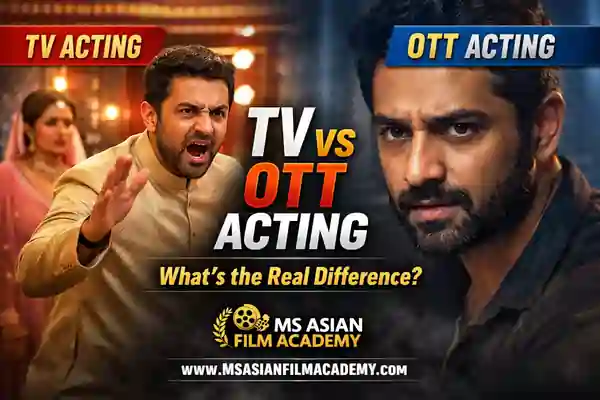
🎬 What is the Difference Between Acting for TV vs OTT? (Complete Guide for Aspiring Actors)
🎭 Introduction
The entertainment industry has evolved dramatically in the last decade. Earlier, television (TV) was the primary platform for actors to gain recognition. But today, with the rise of OTT platforms like Netflix, Amazon Prime, and Hotstar, the acting landscape has changed completely.
If you’re someone dreaming of becoming an actor, understanding the difference between TV acting and OTT acting is extremely important. It not only helps you choose the right career path but also prepares you for auditions and performance expectations.
At MS Asian Film Academy, aspiring actors are trained specifically for both mediums, ensuring they are industry-ready.
📺 What is TV Acting?
TV acting refers to performances in daily soaps, serials, reality shows, and episodic television content broadcasted on channels like Star Plus, Zee TV, Sony TV, etc.
🔹 Key Features of TV Acting:
- Daily or weekly episodes
- Fast-paced shooting schedules
- Long-running storylines
- Wider mass audience reach
TV actors often work for years in the same show, building strong audience familiarity.
📱 What is OTT Acting?
OTT (Over-The-Top) acting involves performances in web series, digital films, and streaming content available online.
🔹 Key Features of OTT Acting:
- Limited episodes (8–12 typical seasons)
- Cinematic storytelling
- High production quality
- Realistic and bold performances
OTT platforms focus more on quality content rather than quantity, giving actors more depth and variety in roles.
⚖️ Major Differences Between TV Acting vs OTT Acting
1. 🎬 Acting Style
TV Acting:
- Slightly exaggerated expressions
- Dramatic tone
- Designed for family audience
OTT Acting:
- Natural and subtle
- Realistic emotions
- Film-like performance
👉 OTT demands more method acting and realism, while TV focuses on visibility and engagement.
2. ⏱️ Shooting Schedule
TV:
- Extremely tight schedules
- Daily episodes require fast shooting
- Less rehearsal time
OTT:
- Flexible schedules
- More preparation time
- Focus on quality over speed
👉 OTT actors get time to live the character, whereas TV actors must perform quickly.
3. 🎥 Production Quality
TV:
- Budget constraints
- Standard sets and lighting
- Repetitive scenes
OTT:
- High-end cinematography
- Advanced storytelling techniques
- Film-level production
👉 OTT feels more like cinema than traditional TV.
4. 📖 Script & Storytelling
TV:
- Extended storylines
- Often repetitive
- TRP-driven
OTT:
- Crisp storytelling
- Finite scripts
- Content-driven
👉 OTT scripts are strong, fresh, and experimental.
5. 👥 Audience Type
TV Audience:
- Family-oriented
- Mass audience
- Traditional viewers
OTT Audience:
- Youth-focused
- Global audience
- Niche viewers
👉 OTT allows actors to gain international recognition.
6. 💰 Payment & Earnings
TV:
- Stable income
- Per episode payment
- Long-term financial security
OTT:
- Higher pay per project
- Short-term contracts
- Performance-based growth
👉 OTT offers higher pay but less consistency, while TV offers steady income.
7. 🌟 Career Growth Opportunities
TV:
- Fame in households
- Limited role variation
- Typecasting risk
OTT:
- Diverse roles
- Faster recognition
- Entry into films
👉 OTT is often considered a launchpad to Bollywood and global cinema.
8. 🎭 Character Depth
TV:
- Limited character development
- Repetitive arcs
OTT:
- Deep character exploration
- Complex personalities
👉 OTT allows actors to showcase their true acting skills.
🚀 Which is Better: TV or OTT Acting?
There is no “one-size-fits-all” answer.
✔️ Choose TV Acting if:
- You want stable income
- You prefer long-term roles
- You enjoy daily performance
✔️ Choose OTT Acting if:
- You want creative satisfaction
- You aim for films or global exposure
- You prefer challenging roles
👉 The smartest approach?
Learn both and adapt.
That’s exactly what MS Asian Film Academy trains actors for—versatility across platforms.
🎓 How to Prepare for TV & OTT Acting?
1. Learn Camera Acting
Understand close-ups, expressions, and body language.
2. Practice Script Reading
OTT especially requires strong dialogue delivery.
3. Build a Portfolio
Professional photos and showreel are essential.
4. Attend Acting Classes
Institutes like MS Asian Film Academy provide industry-level training.
5. Audition Regularly
Consistency is key to breaking into the industry.
🌐 Why Choose MS Asian Film Academy?
At MS Asian Film Academy, students get:
- 🎬 Practical camera training
- 🎭 TV + OTT acting techniques
- 🎥 Portfolio & showreel creation
- 🎤 Audition preparation
- 🌍 Industry exposure
👉 Visit: WWW.MSASIANFILMACADEMY.COM
📊 Future of Acting: TV vs OTT
The future clearly leans toward OTT, but TV is far from over.
- TV still dominates rural and mass audiences
- OTT is growing rapidly in urban and global markets
👉 The industry now values multi-platform actors.
🎯 Final Thoughts
The difference between TV and OTT acting lies in style, opportunity, and storytelling.
- TV = Stability + Mass Reach
- OTT = Creativity + Global Exposure
If you truly want to succeed, focus on skill-building, adaptability, and continuous learning.
And if you’re serious about acting, start your journey with
👉 MS Asian Film Academy
❓ FAQs
1. Is OTT acting better than TV acting?
Not necessarily. OTT offers creative roles, while TV offers stability. It depends on your career goals.
2. Can TV actors move to OTT?
Yes, many TV actors successfully transition to OTT platforms.
3. Which platform pays more, TV or OTT?
OTT generally pays more per project, but TV provides consistent income.
4. Do I need training for OTT acting?
Yes. OTT acting requires natural performance and strong character understanding.
5. How can I start acting in OTT?
- Join acting classes
- Build a portfolio
- Attend auditions
- Network in the industry
6. Is MS Asian Film Academy good for acting?
Yes, MS Asian Film Academy offers professional training for both TV and OTT acting.
Best Acting Classes Near Me – MS Asian Film Academy, Supported by Nav Times News, Powered by MS Groupe