
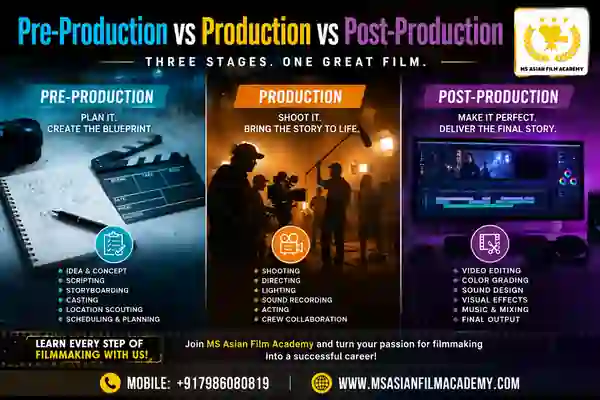
Pre-Production vs Production vs Post-Production: The Complete Filmmaking Process Explained
Every film, web series, or theatre production you have ever watched went through three distinct stages: pre-production, production, and post-production. Understanding pre-production vs production vs post-production is not just useful for directors and producers. It is essential knowledge for every actor who wants to work confidently on a film set, a theatre stage, or a television studio floor.
At MS Asian Film Academy, one of the best acting schools in India, students do not just learn dialogue delivery and emotional expression. They learn how the entire filmmaking process works, from the very first script reading to the final edit. This is what separates a hobbyist from a trained, industry-ready performer.
In this guide, we will break down all three stages of filmmaking in detail, explain why every actor should understand them, and show you how the right acting classes, drama school training, and theatre classes can prepare you for a real career in front of the camera or on stage.
If you are searching for acting classes near me in Chandigarh or looking for the top acting school in India with 100% placement support, this article will help you understand exactly what you are signing up to learn.
What Is Pre-Production?
Pre-production is the planning phase of any film, television show, or theatre production. It happens before a single camera rolls or a single stage light turns on. This stage decides the success or failure of everything that follows.
Think of pre-production as the blueprint stage of a building. Without a solid blueprint, construction cannot begin safely or efficiently. The same logic applies to filmmaking.
Key Elements of Pre-Production
1. Script Development and Screenplay Finalisation The story is broken down scene by scene. Dialogues are finalised, and the screenplay is polished until it is ready for the floor.
2. Casting Directors and casting directors audition actors to find the right fit for each character. This is where trained actors from a recognised drama school or acting classes have a clear advantage, because they already understand audition technique, cold reading, and character interpretation.
3. Budgeting and Scheduling Producers calculate costs, allocate resources, and prepare a shooting schedule that respects everyone’s time and the production’s finances.
4. Location Scouting Teams visit and finalise shooting locations, checking lighting conditions, permissions, and logistics.
5. Storyboarding and Shot Planning Directors and cinematographers plan how each scene will be visually captured, often using storyboards or shot lists.
6. Crew Hiring Cinematographers, costume designers, makeup artists, sound engineers, and assistant directors are brought on board.
Why Pre-Production Matters for Actors
Many aspiring performers assume acting begins on set. In reality, an actor’s real work often begins during pre-production, at the audition table. Understanding how casting decisions are made, how scripts are broken down, and how schedules affect actors is why serious acting classes always include audition training, script analysis, and cold-reading practice as core modules.
What Is Production?
Production is the stage most people associate with filmmaking. This is when the actual shooting happens. Cameras roll, actors perform, and the story starts coming to life exactly as it was planned during pre-production.
Key Elements of Production
1. Principal Photography This is the core shooting phase where scenes are filmed according to the schedule created earlier.
2. Direction and Performance The director guides actors through each scene, working on blocking, emotional beats, and continuity. This is where an actor’s training truly shows.
3. Cinematography and Lighting The camera and lighting teams execute the visual style planned during pre-production, adjusting in real time to achieve the right mood.
4. Sound Recording Production sound recordists capture clean dialogue and ambient sound on location.
5. On-Set Coordination Assistant directors manage timing, actor call sheets, and smooth coordination between departments so that shooting stays on schedule.
Why Production Matters for Actors
Production is unpredictable. Weather changes, retakes happen, and emotional scenes must be repeated multiple times while feeling fresh every time. This is exactly why serious theatre classes and camera-acting workshops focus so heavily on stamina, consistency, and the ability to repeat a genuine emotional performance on command.
An actor trained only in front of a mirror at home often struggles with:
- Hitting precise marks for the camera
- Maintaining continuity of emotion across multiple takes
- Adjusting energy levels for wide shots versus close-ups
- Working with unfamiliar co-actors and directors under time pressure
This is where structured acting classes at a professional institute make a measurable difference, because students rehearse these exact scenarios long before they step onto a real set.
What Is Post-Production?
Post-production begins once shooting wraps. This is where raw footage is transformed into the finished film, show, or advertisement audiences eventually see.
Key Elements of Post-Production
1. Editing Editors assemble the footage, cut scenes together, and shape the pacing and rhythm of the final story.
2. Visual Effects (VFX) Computer-generated elements, background enhancements, and special effects are added where required.
3. Sound Design and Mixing Background score, sound effects, and dialogue are mixed and balanced for the final release.
4. Colour Grading Colourists adjust tone, contrast, and mood to give the film its final visual identity.
5. Dubbing and ADR (Additional Dialogue Replacement) Actors often return to a studio to re-record dialogue that was unclear or needs improvement. This is a skill rarely taught outside professional training.
6. Final Review and Distribution The finished product goes through quality checks before release across theatres, television, or streaming platforms.
Why Post-Production Matters for Actors
Many actors are surprised to learn that a performance is not “finished” once the camera stops rolling. Editors can only work with what was captured, and dubbing artists often need to match lip movements and emotional tone months after the original shoot. Actors trained in voice modulation, breath control, and dialogue delivery through disciplined acting classes and theatre classes find dubbing sessions far easier to navigate than untrained performers.
Common Tools and Roles Used in Each Stage
Understanding the people and tools behind each stage helps actors appreciate how much coordination goes into a single scene. Here is a closer look.
Tools and Roles in Pre-Production
- Screenwriting software such as Final Draft, used to format scripts industry-wide
- Casting sheets and audition tapes, often the very first material a trained actor submits
- Shot lists and storyboards, created by directors and cinematographers
- Budget sheets, prepared by line producers to track every rupee spent
Actors who understand this stage know why punctuality and preparation matter even before the first rehearsal. A well-prepared audition, built through consistent acting classes, often becomes the deciding factor between getting cast or being overlooked.
Tools and Roles in Production
- Cameras and lenses, chosen based on the visual style decided in pre-production
- Clapperboards, used to mark and sync each take
- Continuity reports, maintained so costumes, props, and performances match across scenes shot out of order
- Call sheets, distributed daily so every actor and crew member knows their schedule
Actors trained at a proper drama school understand continuity in a way self-taught performers often miss. Since films are rarely shot in story order, an actor must remember exactly how a character felt, moved, and spoke in a scene filmed weeks earlier. This is a skill that is practised repeatedly in structured theatre classes and rehearsal-based training.
Tools and Roles in Post-Production
- Editing software such as Adobe Premiere Pro or Avid Media Composer
- VFX software for compositing and visual enhancement
- Digital Audio Workstations (DAWs) for sound mixing and score integration
- ADR booths, where actors return to re-record or clean up dialogue
Very few beginner-level courses prepare actors for the ADR process. At MS Asian Film Academy, students practise dubbing and voice matching as part of their core acting classes, so they are never caught off guard when a director calls them back for a re-recording session.
Common Myths About Filmmaking Stages
There are several misconceptions among beginners about how filmmaking actually works. Clearing these up early can save new actors a lot of confusion.
Myth 1: Acting only happens during production. In reality, actors are deeply involved in pre-production through auditions and script readings, and often return during post-production for dubbing sessions.
Myth 2: A good performance on set means the actor’s job is done. A raw performance still passes through editing, colour grading, and sound design before audiences ever see it. Actors who understand this stay patient and professional throughout the entire process, including reshoots.
Myth 3: Talent alone is enough to succeed. Talent matters, but structured training through recognised acting classes, consistent theatre classes, and real audition practice is what turns raw talent into a reliable, hireable skill set.
Myth 4: Bigger cities are the only place to get quality training. Thanks to institutes like MS Asian Film Academy, students searching for acting classes near me in Chandigarh can now access industry-standard training without relocating to Mumbai.
Career Paths That Open Up When You Understand the Full Process
Actors who study the complete filmmaking pipeline, not just performance technique, often find their career options widen significantly. Some paths former students explore include:
- Film and television acting, the most direct path after strong acting classes training
- Theatre performance, built on the foundation of disciplined theatre classes
- Dubbing and voice-over artistry, a growing industry that depends heavily on post-production skill
- Assistant direction, for students who develop an interest in pre-production planning
- Casting associate roles, for those who understand audition processes from both sides of the table
This is one of the strongest arguments for choosing a drama school that teaches the entire filmmaking ecosystem rather than isolated acting tips. Graduates leave with far more career flexibility than performers trained only in front of a mirror or through short online tutorials.
Pre-Production vs Production vs Post-Production: Quick Comparison
| Stage | When It Happens | Main Focus | Key People Involved |
| Pre-Production | Before shooting begins | Planning, casting, budgeting, scripting | Writers, producers, casting directors, actors |
| Production | During filming | Performance, direction, camera work | Directors, actors, cinematographers, sound recordists |
| Post-Production | After shooting ends | Editing, VFX, sound, colour grading | Editors, VFX artists, colourists, dubbing artists |
Understanding this full cycle is what turns a casual performer into a working professional. It is exactly why MS Asian Film Academy structures its curriculum around all three phases, not just camera performance.
Why Every Actor Should Understand the Full Filmmaking Process
A common mistake among beginners is treating acting as an isolated skill. In truth, acting exists inside a larger system, and actors who understand that system have a real career advantage.
Here is why this knowledge matters:
- Better audition performance: Understanding pre-production helps actors prepare smarter for casting calls.
- Stronger on-set confidence: Knowing how production schedules and camera setups work reduces nervousness on set.
- Professional dubbing skills: Awareness of post-production prepares actors for ADR and voice-over work.
- Career versatility: Actors who understand the full pipeline can also explore direction, editing, or production down the line.
This is exactly the philosophy behind training at a genuine drama school rather than a short-term workshop. Real training builds actors who understand the craft from every angle, not just how to deliver a line in front of a camera.
How MS Asian Film Academy Prepares You for Every Stage
If you are searching for the best acting school in India or the top acting school in India, it helps to choose an institute that treats filmmaking as a complete craft rather than a single skill.
At MS Asian Film Academy, students receive hands-on training across:
- Acting classes covering camera technique, emotional range, and character building
- Theatre classes that build stage presence, voice projection, and live performance discipline
- Audition and casting preparation, so students walk into pre-production ready to be selected
- On-set simulation training, so students understand real production environments before their first professional shoot
- Dubbing and voice modulation sessions, preparing students for the realities of post-production
MS Asian Film Academy is recognised as one of the best acting schools in India because it combines classroom learning with real industry exposure, mentorship from working professionals, and a strong placement network.
100% Placement Support
One of the biggest concerns for any student joining an acting institute is what happens after the course ends. MS Asian Film Academy offers 100% placement support, connecting trained students with casting directors, production houses, and ongoing film and television projects. This is a major reason the academy is regarded as a top acting school in India for serious, career-focused students.
Acting Classes Near Me in Chandigarh
If you have been searching for acting classes near me in Chandigarh, MS Asian Film Academy offers structured, professional training right in the region. Students no longer need to relocate to Mumbai or Delhi just to receive quality film education.
Chandigarh-based students can now access:
- Professional acting classes taught by industry-experienced faculty
- A full-fledged drama school environment for stage and screen performance
- Practical theatre classes that build real performance discipline
- Direct exposure to pre-production, production, and post-production workflows
This makes MS Asian Film Academy a convenient and credible choice for anyone in Chandigarh and the surrounding Tricity region who is serious about building an acting career.
Frequently Asked Questions
What is the difference between pre-production, production, and post-production? Pre-production is the planning stage, including scripting, casting, and scheduling. Production is the actual filming stage. Post-production is everything that happens after filming, including editing, sound design, VFX, and colour grading.
Which stage of filmmaking is most important for actors? All three stages matter, but production is where actors perform on camera. However, pre-production (auditions) and post-production (dubbing) also directly involve actors, which is why understanding the full process gives performers a career advantage.
Do acting classes teach students about the filmmaking process? Yes. Quality acting classes at institutes like MS Asian Film Academy include training on auditions, on-set etiquette, camera technique, and dubbing, giving students a complete understanding of pre-production, production, and post-production.
Is MS Asian Film Academy a good option for beginners? Yes. MS Asian Film Academy welcomes beginners and trains them from foundational acting classes and theatre classes through to advanced camera and audition preparation, supported by 100% placement assistance.
Are there acting classes near me in Chandigarh for working professionals? Yes. MS Asian Film Academy offers flexible batches suitable for students, working professionals, and career-changers looking for acting classes near me in Chandigarh.
What makes MS Asian Film Academy the best acting school in India? Its combination of practical drama school training, real industry mentorship, structured theatre classes, and a proven 100% placement track record makes it stand out among acting institutes across the country.
Ready to Start Your Acting Journey?
Understanding pre-production vs production vs post-production is the first step toward becoming a well-rounded performer. The next step is training under professionals who can turn that understanding into a real career.
Join MS Asian Film Academy, recognised as one of the best acting schools in India, offering acting classes, drama school programs, and theatre classes with 100% placement support.
📞 Call now: +91 7986080819 🌐 Visit: www.msasianfilmacademy.com
Whether you are searching for acting classes near me in Chandigarh or looking for the top acting school in India, your journey toward a professional acting career starts with a single phone call.
Pre-Production vs Production vs Post-Production– Supported by Nav Times News, Powered by MSasian Entertainment , Supported by MSAFA