
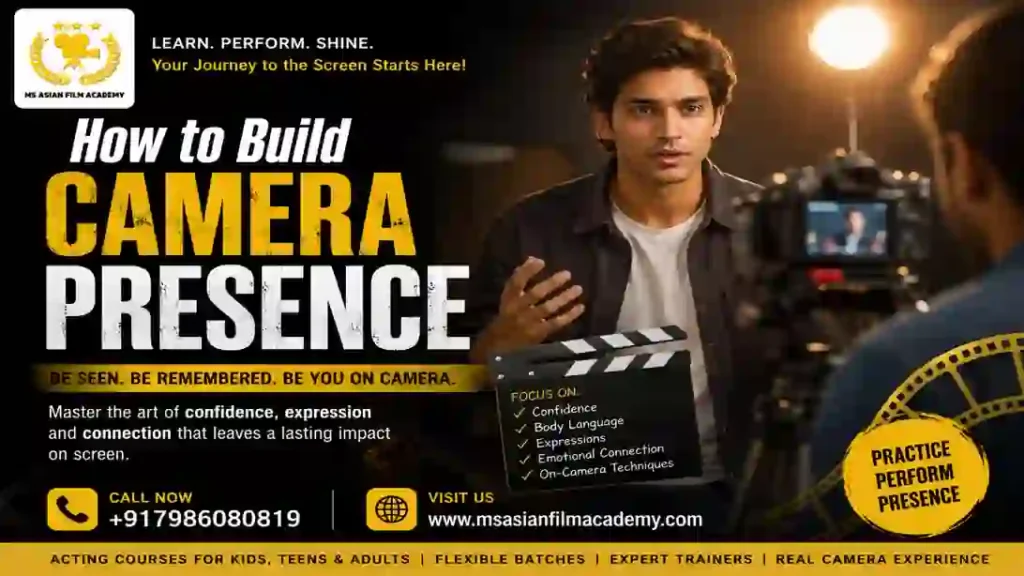
How to Build Camera Presence: Tips from Acting Coaches
How to Build Camera Presence -Walk onto any film set, and you’ll notice something immediately: some actors seem to glow the moment the camera turns on, while others — technically skilled, line-perfect, well-rehearsed — simply don’t. That difference has a name. Acting coaches call it camera presence, and unlike raw talent, it is a skill you can learn, practice, and refine.
Camera presence is not about being the loudest person in the room or having striking looks. It’s about a quiet, magnetic connection between the actor, the lens, and the audience watching on the other side of it. Whether you’re preparing for a screen test, building a showreel, or simply want to feel more confident in front of a camera, understanding how professional actors develop this skill can transform the way you perform.
In this guide, we break down exactly what camera presence is, why it matters more than ever in today’s content-driven entertainment industry, and the specific techniques acting coaches use to help students develop it — whether in a classroom, on a film set, or during a self-tape audition at home.
What Is Camera Presence, Exactly?
Camera presence is the ability to hold an audience’s attention and communicate emotion authentically through the lens, without relying on the exaggerated physicality that stage acting sometimes demands. It’s a combination of stillness, intention, breath control, and emotional truth — all calibrated for a medium that captures the smallest flicker of the eye.
On stage, an actor projects to the back row. On camera, that same energy reads as false or overacted. The camera is intimate. It sees everything — hesitation, tension in the jaw, a genuine versus performed smile. This is why many acting coaches say camera acting is really about subtraction: doing less, but meaning more.
Strong camera presence typically includes:
- A relaxed, grounded physical presence
- Genuine eye contact with the lens or scene partner
- Controlled breathing that supports natural speech rhythm
- Emotional availability without exaggeration
- An awareness of framing, marks, and camera angles
Why Camera Presence Matters More Than Ever
The entertainment industry has changed dramatically. Auditions increasingly happen via self-tape rather than in-person casting rooms. Content is consumed on OTT platforms, YouTube, and social media, where close-up shots dominate. Directors and casting agents today are not just looking for actors who can deliver lines — they’re looking for people the camera wants to watch.
This is exactly why structured training matters. A good drama school doesn’t just teach memorization or diction — it teaches actors how to exist naturally in front of a lens, under studio lights, with a crew watching. This is a core part of what’s covered in professional acting courses, where students get hands-on camera practice from day one rather than learning theory alone.
Tip 1: Master Stillness Before Movement
One of the first lessons acting coaches teach is that stillness reads as confidence, while excessive movement reads as nervousness. Beginners often feel the urge to fill silence with gestures, shifting weight, or unnecessary facial movement. On camera, this creates visual noise that distracts from the emotional core of a scene.
Coach’s tip: Practice sitting or standing in front of a mirror or camera for two full minutes without moving unnecessarily. Focus only on your breath and your thoughts. This builds the muscle of “active stillness” — where you are internally alive but externally calm.
Tip 2: Build a Genuine Connection with the Lens
Many new actors either avoid the camera lens entirely or stare at it too intensely, both of which feel unnatural on screen. Coaches often describe the lens as “a trusted friend” — you’re not performing at it, you’re communicating through it.
A useful exercise taught in many acting course modules is to imagine a specific person just behind the camera — someone you’d naturally want to share this moment with. This small mental shift softens the eyes and removes the “performing” quality that reads as false on screen.
Tip 3: Control Your Breath to Control Your Energy
Breath is the single most underrated tool in an actor’s toolkit. Shallow, anxious breathing tightens the voice, speeds up delivery, and creates visible tension in the shoulders and neck — all of which the camera picks up instantly.
Acting coaches often begin camera-training sessions with breathing exercises:
- Box breathing — inhale for 4 counts, hold for 4, exhale for 4, hold for 4. Repeat before every take.
- Diaphragmatic breathing — breathing from the belly rather than the chest keeps the voice grounded and prevents nervous, high-pitched delivery.
- Breath-and-release before “action” — a single deep breath followed by a full release just before the scene begins signals the body to relax.
Tip 4: Understand Scale — Less Is More
Camera acting scale is dramatically smaller than theatre acting scale. A raised eyebrow, a subtle breath catch, or a slight tightening of the jaw can convey as much emotion in close-up as a full-body gesture would on stage.
This is one of the biggest adjustments actors trained in theatre classes need to make when transitioning to screen work — and a well-rounded acting program should teach both, so students understand when to project and when to hold back.
Practical exercise: Perform the same short monologue three times — once as if performing for a 500-seat theatre, once for a 50-seat black box theatre, and once directly into a phone camera. Notice how the physical and vocal choices must shrink at each stage.
Tip 5: Learn to Hit Your Marks Without Looking Down
Marks are the small tape indicators on set that tell an actor exactly where to stand for focus and lighting. New actors often glance down to check their footing, which breaks the illusion of presence and reads as unprofessional to directors.
Coaches train this through repetition — walking to a mark, hitting it precisely using peripheral vision and muscle memory, while maintaining full eye contact and emotional continuity in the scene. This is a small technical skill, but it’s one casting directors notice immediately, and it’s part of the practical, set-ready training emphasized in serious film making course programs.
Tip 6: Study Framing and Angles Like a Director Would
Actors with strong camera presence understand how they’re being shot — whether it’s a wide shot, medium shot, or extreme close-up — and adjust their performance scale accordingly. An actor who understands blocking and camera language becomes significantly easier for a director to work with, and often gets more meaningful screen time in the edit.
This is why the most respected acting programs pair actor training with a foundational understanding of the director’s perspective. Students who also explore a film direction course alongside their acting training tend to develop a much sharper instinct for camera awareness — they start thinking about how a scene will actually look, not just how it feels to perform.
Tip 7: Warm Up Your Face and Voice Before Every Take
Camera presence isn’t just mental — it’s physical. Facial tension shows up instantly in close-up shots. Before any on-camera work, coaches recommend a short physical warm-up:
- Gentle facial stretches and jaw releases to avoid stiff, tense expressions
- Vocal warm-ups (humming, lip trills) to keep the voice relaxed and resonant
- Shoulder rolls and neck stretches to release tension that creeps into posture
A tense actor almost always looks less confident on screen than a relaxed one, regardless of how good the performance itself is.
Tip 8: Practice Self-Tapes Relentlessly
Since so much casting now happens through self-tape submissions, learning to perform confidently for a camera with no crew, no director, and no scene partner in the room is a non-negotiable modern skill.
Coach’s checklist for self-tapes:
- Frame yourself from mid-chest up, with the eye line just below the lens
- Use natural, soft lighting facing you — never backlit
- Keep the background simple and non-distracting
- Do at least 3–5 takes and review each one critically before submitting
- Record vertically for social platforms, horizontally for traditional casting
Recording yourself repeatedly and watching it back — uncomfortable as that can be — is one of the fastest ways to build authentic camera presence, because it trains you to see yourself the way the audience will.
Tip 9: Build Confidence Through Repetition, Not Perfection
Confidence on camera doesn’t come from getting it “right” the first time — it comes from repeated exposure until the camera stops feeling foreign. Structured acting classes that include regular on-camera scene work, mock auditions, and recorded feedback sessions help students build this comfort systematically, rather than leaving it to chance on a real set.
Tip 10: Learn to Take Direction Quickly and Naturally
Directors often give quick adjustment notes between takes — “more internal,” “bigger,” “slower,” “find the joy in this line.” Actors with strong camera presence can absorb a note and adjust instantly without overthinking or losing the authenticity of the moment. This responsiveness is a trained skill, built through repeated on-set style exercises in a structured acting program rather than something that develops naturally on its own.
How the Right Training Environment Builds Camera Presence Faster
While self-practice helps, camera presence develops fastest under the guidance of experienced coaches who can give real-time, specific feedback — something a mirror or a phone camera alone cannot provide. This is the advantage of enrolling in a dedicated acting classes near me in Chandigarh program, where students train on actual camera equipment, under studio lighting, with industry-experienced faculty watching every take.
For students who are also drawn to on-screen versatility, exploring a modelling course alongside acting training can further sharpen camera awareness, posture, and comfort in front of a lens — skills that transfer directly into screen acting.
If you’re searching for the best acting school in India or comparing options for the top acting school in India, look for programs that combine camera technique, on-set etiquette, and real industry exposure — not just classroom theory. A genuinely strong program should also offer placement support, connecting trained actors directly with productions once they complete their training.
Common Camera Presence Mistakes to Avoid
- Overacting for the lens — camera acting rewards subtlety, not intensity
- Breaking eye line repeatedly — glancing away breaks audience connection
- Rushing lines from nerves — controlled pacing reads as confidence
- Ignoring continuity — repeating the same gesture inconsistently across takes confuses editors
- Neglecting physical warm-ups — tension is the enemy of natural presence
Frequently Asked Questions –How to Build Camera Presence
What exactly is camera presence in acting? Camera presence is an actor’s ability to hold audience attention and convey genuine emotion through the lens, using controlled stillness, breath, and subtle expression rather than exaggerated stage-style performance.
Can camera presence really be learned, or is it natural talent? It can absolutely be learned. While some people are naturally more comfortable on camera, camera presence is primarily a technical and psychological skill built through repetition, feedback, and structured training — not an innate gift.
How long does it take to develop strong camera presence? Most students notice meaningful improvement within a few weeks of consistent, focused on-camera practice, though ongoing refinement continues throughout an actor’s career.
Do I need to attend an acting school to build camera presence, or can I self-teach? Self-practice with a phone camera helps, but structured feedback from experienced coaches accelerates progress significantly, since actors often can’t spot their own tension or habits without an outside eye.
What is the difference between stage presence and camera presence? Stage presence relies on projected energy and larger physical expression to reach a live audience, while camera presence depends on subtlety, stillness, and intimate emotional truth captured in close-up.
Why do self-tapes matter so much in today’s casting process? Since most initial auditions now happen remotely, an actor’s ability to perform confidently and naturally on a self-tape, without a director or scene partner present, has become an essential professional skill.
Final Thoughts –How to Build Camera Presence
Camera presence isn’t magic — it’s a craft built from breath control, stillness, genuine emotional connection, and technical awareness of how the camera actually sees you. Every professional actor you admire on screen has spent hours in training rooms, under studio lights, learning exactly the techniques covered in this guide.
If you’re serious about developing camera presence and building a real career in front of the lens, the fastest path forward is structured, hands-on training with experienced coaches who can guide you take by take.
Ready to start building your camera presence with expert guidance? MS Asian Film Academy offers industry-focused acting classes, drama school training, and theatre classes in Chandigarh, with 100% placement support to help you turn training into a real career. Explore our full range of courses or call us directly at +91 7986080819 to book your consultation today.
Visit us at www.msasianfilmacademy.com to learn more.
How to Build Camera Presence – Supported by Nav Times News, Powered by MSasian Entertainment , Supported by MSAFA