
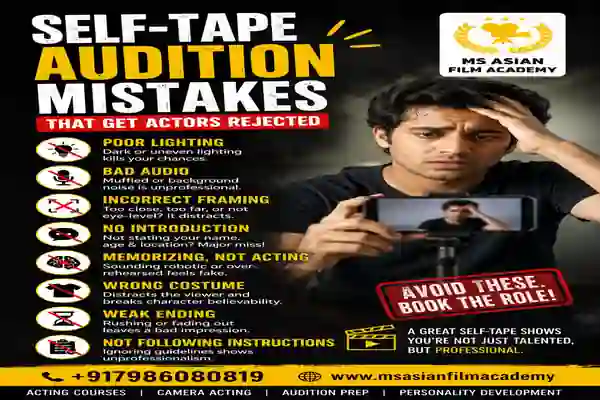
Self-Tape Audition Mistakes That Get Actors Rejected
Self-tape auditions have completely changed how actors get discovered in India and around the world. Casting directors no longer need actors to travel across cities for a two-minute audition. Instead, a well-shot self-tape can open doors to films, web series, and commercials, all from the comfort of home. But here’s the catch: while self-tapes have made auditions more accessible, they’ve also made rejection faster and easier. A single technical glitch, an awkward camera angle, or a poorly chosen background can get your audition dismissed within seconds, no matter how talented you are.
At MSAFA (MS Asian Film Academy), one of the leading acting institutes in North India, we’ve reviewed thousands of self-tapes from aspiring actors. And we’ve noticed a pattern: the same handful of mistakes show up again and again, quietly ending careers before they even begin. In this guide, we’re breaking down the most common self-tape audition mistakes that get actors rejected, and exactly how to avoid them.
Whether you’re a complete beginner or someone who’s been auditioning for a while without much luck, this article will help you understand what casting directors actually notice, and what makes them skip to the next file without a second thought.
Why Self-Tape Auditions Are Different From Live Auditions
Before diving into the mistakes, it’s important to understand why self-tapes carry different risks than in-person auditions. In a live room, a casting director experiences your energy directly. They may forgive a shaky start or a nervous laugh because they can sense your presence. A self-tape offers no such grace. It’s judged purely on what appears on screen, in isolation, often on a small laptop screen alongside fifty other submissions.
This means every element, lighting, sound, framing, performance choices, and even your file name, becomes part of the evaluation. Casting directors and producers are sifting through hundreds of tapes for a single role, and they simply don’t have time to figure out if your framing is off because of nerves or negligence. They just move on.
This is exactly why structured training matters. At our acting course, we dedicate specific modules to self-tape technique, because this skill is now as essential as voice modulation or emotional range.
1. Poor Lighting That Hides Your Performance
This is, without question, the most common and most avoidable mistake. Actors often shoot in dim rooms, with a light source behind them, or under harsh overhead lighting that casts shadows across the face. If a casting director can’t see your eyes clearly, they can’t judge your performance. Emotion lives in the eyes, and if they’re lost in shadow, so is your chance.
The fix: Always face a natural or soft artificial light source. A window facing you (not behind you) during daytime works wonderfully. If shooting indoors at night, invest in an affordable ring light or softbox. Avoid mixed lighting (yellow bulb plus white light), as it creates unnatural skin tones on camera.
2. Distracting or Unprofessional Backgrounds
A cluttered bedroom, a busy family kitchen, or a wall covered in posters pulls focus away from your performance. Casting directors want to see your face, your expressions, your instrument, not what’s happening in your background. Some actors even accidentally include family members walking by or pets wandering into frame.
The fix: Choose a plain, neutral-colored wall (grey, beige, or muted blue works best). Keep at least three feet of distance between you and the wall to avoid harsh shadows. Remove anything distracting from the frame before you press record.
3. Incorrect Framing and Camera Angles
Many self-tapes get rejected simply because the actor is framed incorrectly. Shooting too wide (showing the actor from the waist up with excessive headroom) or too tight (cutting off the forehead or chin) are both common issues. Camera placed too low creates an unflattering angle and often signals inexperience to casting professionals.
The fix: The standard self-tape frame is a medium close-up: from mid-chest to just above the head, with minimal headroom. Position the camera at eye level, never below. Use a tripod or stable surface, handheld shots almost always look unprofessional and shaky.
4. Reading Directly Into the Lens Instead of Off-Camera
A common instinct for beginners is to look straight into the camera lens while performing, like a newsreader. This breaks the illusion of a scene and feels unnatural for most dramatic material, unless specifically requested (such as for a commercial or direct address piece).
The fix: Your reading partner (the person feeding you lines) should stand as close to the lens as possible, just beside it, so your eyeline appears just off-camera. This creates a natural, engaged scene partner illusion without literally staring into the lens.
5. Weak or Distracting Reader Performance
Speaking of reading partners, this is a mistake many actors don’t realize is even a mistake. If your scene partner reads lines flatly, mumbles, or gives you zero energy to react to, your own performance suffers. Some actors even attempt to record solo, playing both characters, which almost never works convincingly.
The fix: Choose a reader who can commit to giving you real energy, even if their voice isn’t heard clearly in the final edit (many editors lower the reader’s volume). At MSAFA, students in our theatre classes practice paired scene work specifically to build this skill of both giving and receiving energy on camera.
6. Bad Audio Quality
Video quality often gets all the attention, but poor audio is just as damaging. Echoing rooms, background noise (fans, traffic, family conversations), or audio that’s too quiet can make a casting director strain to understand your lines, and frustration leads to quick rejection.
The fix: Shoot in a room with soft furnishings (curtains, carpets, cushions) to reduce echo. Turn off fans and air conditioners while recording. Use an external mic or even a phone earphone mic if you don’t own dedicated audio equipment. Always do a test recording and listen back with headphones before your final take.
7. Ignoring the Casting Instructions
This mistake has nothing to do with performance and everything to do with professionalism. Casting directors often specify exact requirements: file naming conventions, video length, specific slating instructions (“state your name, height, and city”), or particular scene sides. Actors who ignore these instructions signal that they may be difficult to direct on set.
The fix: Read the casting brief twice before recording. Follow file naming formats exactly as requested (usually “YourName_RoleName_Date”). If they ask for a slate at the start, don’t skip it, even if you feel it’s unnecessary.
8. Overacting for the Camera
Theatre training teaches projection and big physical choices that read well from the back row of an auditorium. But camera acting demands something entirely different: subtlety. Many actors transitioning from stage to screen (or those without proper film training) overact, exaggerated facial expressions, unnecessarily loud line delivery, or overly dramatic pauses that feel forced on camera.
The fix: Remember that the camera captures the smallest of expressions. A slight eyebrow raise or a subtle breath can communicate more than a large gesture. This is a core distinction we teach in our film-making course, where students learn how differently the camera “reads” performance compared to a live stage.
9. Submitting Without Multiple Takes
Some actors record a single take and submit it immediately, without reviewing it critically. This often means the first noticeable flaw, a fumbled line, an odd expression, an audio hiccup, ends up in the final submission simply because there was no second attempt.
The fix: Always record at least three to five takes. Watch each one back critically, as if you were the casting director. Choose the take where your performance feels most alive and truthful, not necessarily the most technically “clean” one, unless a technical flaw is genuinely distracting.
10. Poor Slating Technique
The slate, that brief introduction where you state your name and sometimes other details, is often the first thing a casting director sees. A nervous, mumbled, or overly casual slate creates a poor first impression before your actual performance even begins.
The fix: Practice your slate as much as your scene. Stand confidently, smile naturally, state your name clearly, and pause briefly before beginning the scene. This small detail is trained specifically in our acting course, where students practice slating until it becomes second nature.
11. Choosing the Wrong Outfit or Look
Wearing overly patterned clothing, distracting jewelry, or costumes that try too hard to “look like the character” often works against actors. Casting directors want to imagine you as the character, not see a costume that oversells the point.
The fix: Choose solid colors that suit your skin tone and avoid busy patterns or logos. Dress in a way that hints at the character (a suit for a corporate role, casual wear for a college student) without turning it into a full costume.
12. Not Making Bold Character Choices
Ironically, while overacting is a mistake, so is playing it too safe. Many actors deliver technically correct but emotionally flat performances because they’re afraid of making a wrong choice. Casting directors would rather see a bold, specific choice that doesn’t quite work than a generic, forgettable one.
The fix: Commit fully to a specific interpretation of the character. Ask yourself what this character wants in the scene, and let that objective drive every line and pause. Specificity almost always reads as stronger acting, even when the choice itself is debatable.
13. Uploading in the Wrong Format or File Size
Finally, a purely technical mistake: submitting files that are too large, in unsupported formats, or with shaky, unstable internet uploads that corrupt the file. Casting directors receiving broken or unplayable files often won’t bother requesting a resend, they’ll simply move to the next actor.
The fix: Compress your video appropriately (usually MP4 format works universally) while maintaining clarity. Test the file on a different device before submitting to confirm it plays correctly.
How MSAFA Prepares Actors for Self-Tape Success
At MS Asian Film Academy, we understand that today’s actor needs to be camera-ready, tech-savvy, and emotionally truthful, all at once. Our training doesn’t stop at classroom acting theory. We simulate real audition conditions, teach practical self-tape setup using affordable home equipment, and give students individual feedback on their tapes before they submit to real castings.
Our courses are designed by industry professionals with real casting and production experience, ensuring our students don’t just learn to act, they learn to get cast. We also offer specialized training through our film direction course and modelling course, both of which complement an actor’s understanding of how they’re seen and evaluated on camera.
If you’re searching for acting classes near me in Chandigarh, MSAFA is recognized as one of the best acting schools in India and the top acting school in India for a reason: our students don’t just train, they work. With our 100% placement support, students are guided from their first audition tape to their first professional credit.
MSAFA operates under the wider entertainment ecosystem of our production house, MS Groupe, which means our students have direct exposure to real productions, real casting opportunities, and real industry mentorship, something few acting schools or drama schools in India can genuinely offer.
Final Thoughts (Self-Tape Audition Mistakes That Get Actors Rejected)
Self-tape auditions have democratized the casting process, but they’ve also raised the bar for what’s considered a “presentable” audition. Talent alone is no longer enough; actors today need to understand lighting, framing, sound, and performance nuance, all working together in a single take. The good news is that every mistake covered in this article is entirely fixable with the right guidance and practice.
If you’re serious about building a career in front of the camera, don’t leave your self-tape skills to guesswork. Structured training in acting classes, drama school, and theatre classes can be the difference between a tape that gets ignored and one that gets you cast.
Ready to Master Your Self-Tape Auditions? (Self-Tape Audition Mistakes That Get Actors Rejected)
Join MSAFA, the best acting school in India, and get hands-on training in self-tape technique, camera presence, and professional audition skills, backed by our 100% placement support.
📞 Call us now at +91 7986080819 to book your free consultation and take the first step toward your acting career.
🌐 Visit www.msasianfilmacademy.com to explore our courses today.
Self-Tape Audition Mistakes That Get Actors Rejected –Supported by Nav Times News, Powered by MSasian Entertainment , Supported by MSAFA