
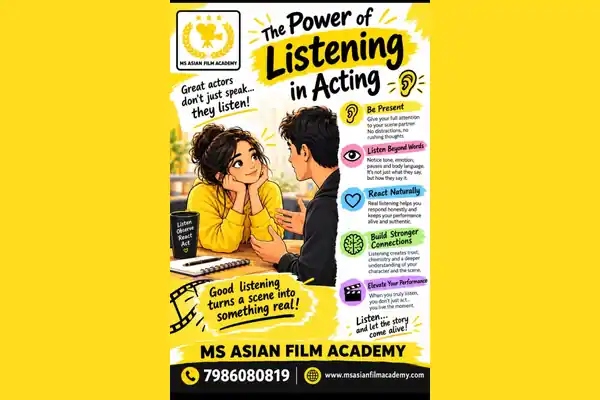
The Power of Listening in Acting: Why the Best Actors Listen More Than They Speak
Ask any casting director what separates a good actor from a memorable one, and you will rarely hear “better dialogue delivery.” You will hear something quieter: “They were actually present in the scene.” That presence comes from one skill most beginners overlook. The power of listening in acting decides whether a performance feels alive or rehearsed, and it is the first thing a trained eye notices in an audition room.
At MS Asian Film Academy, we see this in almost every new batch. A student walks in with a strong voice, a good memory for lines and plenty of confidence. Then we hand them a simple two-person scene, and the problem shows up straight away. They are not listening. They are waiting. This guide explains the difference, why it matters for your career, and how to train it properly.
What Does Listening Actually Mean in Acting?
In everyday life, listening means taking in sound. In acting, listening means allowing what your scene partner says and does to change you, in real time.
A person who is only waiting for their turn hears the words, but nothing inside them moves. A listening actor reacts to the tone, the pause, the glance away, the half-finished sentence. Their next line comes out of that experience, not out of the script alone. (The Power of Listening in Acting)
Think of a real argument between two people. Neither knows exactly what the other will say next. Each sentence lands, hurts or surprises, and the reply follows from that feeling. Good acting recreates this. The lines are fixed, but the discovery has to feel new every time you perform them.
That is why listening is not a passive skill. It is the active engine of the performance. If you want to understand the foundations of this craft more broadly, our acting course in Chandigarh builds listening into the training from the very first week. (The Power of Listening in Acting)
Why Listening Is the Foundation of Truthful Acting
Audiences can forgive many flaws. They forgive a weak accent, an awkward walk, even a flat voice. What they do not forgive is falseness. The moment an actor seems to be “performing” a line instead of living it, the audience pulls back emotionally.
Listening protects you from falseness for three reasons.
1. It keeps you in the present moment. Most stage fright and camera anxiety comes from the mind running ahead: “What’s my next line? Am I looking good? Did I forget the blocking?” When you place your full attention on your partner, that inner chatter loses its grip. You cannot worry about yourself and truly listen at the same time.
2. It makes your reactions specific. A generic reaction looks the same in every scene. A reaction born from listening is shaped by exactly what was said and how. This specificity is what people mean when they praise a performance as “natural.”
3. It makes the whole scene better. Acting is a team sport. When you listen well, you give your partner something real to respond to. Scenes lift when both actors do this, and they die when only one does.
Listening vs. Waiting for Your Cue: The Mistake Almost Every Beginner Makes
Here is a pattern we see again and again in our drama school sessions. A student memorises the entire scene, including their partner’s lines. During practice, they mouth along silently, or their eyes glaze over while the other person speaks. The moment the partner’s last word arrives, they snap back to life and deliver their line.
Technically, the cue was picked up. Emotionally, nothing happened in between.
Here is a quick way to tell whether you are listening or waiting:
- Waiting: your face is blank or frozen while the other actor speaks, and you only “turn on” when it’s your line.
- Listening: your breathing, eyes and facial muscles shift while the other person speaks, even if you say nothing.
A useful rule from the rehearsal room: if the camera were only on your face during your partner’s dialogue, would the audience still understand what you are feeling? On screen, a close-up of the listener is often the most powerful shot in the scene. Directors know this, and so do experienced actors.
The Five Layers of Listening Every Actor Should Train
Listening is not one skill. It works in layers, and strong actors learn to use all of them together.
1. Listening with your ears
This is the basic layer: hearing the actual words, the rhythm, the volume, the hesitation. Many actors skip it because they already know the script. Hear it as if for the first time.
2. Listening with your eyes
Watch your partner’s face, hands, posture and where their eyes go. A character may say “I’m fine” while gripping a glass too tightly. If you only listen to the words, you miss the real scene.
3. Listening with your body
Your body picks up energy before your mind names it. When your partner steps closer, your chest tightens. When they pull away, something drops in your stomach. Let those physical responses happen instead of blocking them. (The Power of Listening in Acting)
4. Listening to the silence
Pauses carry meaning. A long silence after a question can be an answer in itself. Beginners rush to fill silence. Experienced actors let it work.
5. Listening to yourself
This one surprises people. Good actors also notice their own impulses: a sudden urge to look away, a lump in the throat, a smile they did not plan. Following these honest impulses, within the limits of the scene, is what creates surprising, human moments.
Listening in Theatre vs. Listening on Camera
Both stage and screen need listening, but they ask for it differently, and a well-rounded actor learns to adjust. If you are curious about the broader differences, we cover them in our guide on theatre acting versus camera acting, but here is the short version.
On stage, you share the same air as your partner and the audience. Your listening has to be visible enough to reach the back row, yet still honest. Because theatre runs in continuous takes, you build listening stamina: staying alive in a scene for ten, twenty or forty minutes without a cut.
On camera, the lens catches the tiniest shift. A slight narrowing of the eyes can carry a whole thought. Here, listening has to be smaller and more internal. But film also brings its own challenge: scenes are shot out of order, in fragments, and your partner may not even be on set during your close-up. You may have to listen to an off-camera voice, or to a script supervisor reading lines, and still react as though the real person were in front of you.
This is one reason we encourage students to join theatre classes alongside screen training. Theatre builds the muscle of sustained attention, and screen work refines it. Together they create a flexible actor who can walk into any room.
How Listening Shows Up in Auditions
Auditions are short, nerve-racking and often awkward. You may be reading with a casting associate who is looking at their phone, or performing to an empty chair. Many actors treat this as an obstacle. Smart actors treat it as a chance to show listening skill.
Here is what casting teams quietly watch for:
- Do you react to the reader’s lines, or just wait? Even if the reader is flat, the actor who listens stays alive.
- Can you adjust? When a director gives a note like “try it softer,” your ability to take direction is really a listening test.
- Do you pause naturally? Actors who listen leave real beats between lines, rather than racing through the pages.
- Do you stay in the scene after the last line? The moment after your final word is still part of your performance. Don’t drop character the instant you finish.
If you want to understand more about what casting professionals look for in new talent, our team at MS Asian Film Academy shares industry-focused guidance across all our programs.
The Meisner Approach and the Repetition Exercise
Many acting schools around the world draw on the work of Sanford Meisner, an American acting teacher who built an entire technique around listening and reacting honestly. His best-known tool is the repetition exercise, and it is simpler than it sounds. (The Power of Listening in Acting)
Two actors sit facing each other. One makes a simple, factual observation about the other, such as “You’re wearing a blue shirt.” The partner repeats it back: “I’m wearing a blue shirt.” They keep repeating, back and forth. At first it feels silly. Then something shifts. The tone changes as the partner’s face changes. One person laughs, the other gets irritated, and the same four words begin to carry real feeling.
The point is not the words. The point is that you are forced to respond to behavior, not to language. You stop planning and start reacting. Students often tell us this exercise is the first time they truly understood what “being in the moment” means.
You don’t need a stage to try a basic version at home. Find a friend, pick a neutral sentence, and repeat it back and forth for five minutes, watching each other’s face. Notice what changes.
Practical Exercises to Strengthen Your Listening Skills
Listening improves with practice, like any other skill. Here are exercises you can start this week.
1. The paraphrase exercise. In normal conversation, before answering, silently restate what the other person just said in your own head. This builds the habit of actually absorbing information rather than preparing your reply.
2. The “one thing you noticed” drill. After any conversation, write down one small detail you noticed about the other person: a change in voice, a gesture, a word they emphasized. Over time you become more observant.
3. Scene partner swap. Rehearse the same scene with three different partners. Notice how your performance changes. If it doesn’t, you may be performing a fixed version instead of listening.
4. Silent scene. Perform a short scene using only eye contact, breath and small movements, with no dialogue. This trains you to communicate and receive through behavior.
5. Blind listening. One actor sits with eyes closed while a partner reads a short monologue. The listener describes what they felt and pictured. It sharpens the ear.
6. Reverse the cue. Take a scene you know well and speak your lines only after you genuinely feel the urge to speak. Dropped lines are fine here. You are retraining your instinct to respond instead of recite.
Practice for 15 to 20 minutes daily. Consistent small effort beats occasional long sessions.
Common Listening Mistakes That Hurt Performances
Over the years, a few habits have come up repeatedly in our classrooms. If you recognize any of them in yourself, don’t worry. They are all fixable.
- Over-rehearsing line readings. Locking in exactly how every line will sound leaves no room for response.
- Watching yourself. Some actors monitor their own face or voice constantly, which pulls attention away from the scene partner.
- Anticipating the reply. If you know the next line, it is tempting to react before the words are spoken. Hold back and let it land first.
- Acting at your partner, not with them. When two actors deliver monologues at each other instead of exchanging energy, the scene feels stagey.
- Fear of silence. Rushing to fill every pause removes the tension that makes scenes watchable.
- Dropping focus off-camera. On a film set, some actors “switch off” when the camera isn’t on them. This damages the other actor’s performance and your own continuity. (The Power of Listening in Acting)
How Acting Classes Develop Listening in a Structured Way
Reading about listening is useful, but you cannot fully learn it from a book or a video. It lives in the space between two or more people, which is why in-person training matters so much.
Good acting classes build listening step by step:
- Awareness exercises to relax the body and sharpen attention.
- Partner work such as repetition, mirroring and sensory exercises.
- Scene study where listening is applied to written material.
- Camera practice so you can see how your reactions look on screen.
- Feedback and review from experienced trainers who spot the moments you stopped listening before you notice them yourself.
That last point is important. Most actors cannot see their own blind spots. A trainer watching from outside can tell you, “At the second line you went blank, and you stopped hearing him.” That single observation can change a performance.
At MS Asian Film Academy, we combine this training with practical exposure through our parent company, MS Groupe, a production house, so students learn in an environment that is close to real industry work rather than purely classroom theory.
What to Look for When Choosing a Drama School
If you are searching for the best acting school in India or the top acting school in India, rankings and brochures alone won’t tell you much. Ask practical questions instead.
- Is the training hands-on? You should be performing scenes every week, not just listening to lectures.
- Who are the trainers? Look for people with real industry experience, not only academic credentials.
- Is there camera training? Modern acting careers involve film, web series, ads and OTT. Screen readiness is essential.
- Are batches small enough for personal feedback? Listening skills are developed through attention to each individual.
- What happens after the course? Placement support, portfolio help and industry connections matter as much as the curriculum.
- Does the school offer related skills? Actors benefit from understanding film direction, film making and even modelling, because knowing how the whole production works makes you a smarter performer.
If you are looking for acting classes near me in Chandigarh, visit the academy, sit in on a class if possible, and judge for yourself how the trainers work with students. A good school will welcome that.
Why Students Choose MS Asian Film Academy
MS Asian Film Academy is a Chandigarh-based drama school and film institute built for aspiring actors, filmmakers and creative professionals across North India and beyond. Our approach is simple: train actors to be honest, present and professionally prepared.
Here is what students can expect:
- Practical, scene-based training where listening, reacting and emotional truth are taught through daily exercises.
- Theatre and camera exposure, so you can move comfortably between stage and screen.
- Experienced trainers who give direct, personal feedback.
- 100% placement assistance, including support with portfolio building, auditions and industry introductions.
- Industry connection through MS Groupe, our production house.
- A range of courses, from acting to direction, film making and modelling. You can explore the full list on our courses page.
We don’t promise overnight stardom, because no honest institute can. What we promise is serious training, consistent guidance and a real pathway into the industry for students who put in the work. (The Power of Listening in Acting)
Frequently Asked Questions About Listening in Acting
Why is listening so important in acting?
Listening keeps an actor present and responsive. It turns memorised lines into genuine reactions, which makes the performance believable. Without it, even well-delivered dialogue feels mechanical.
Can listening be learned, or is it a natural talent?
It can absolutely be learned. Some people are naturally attentive, but everyone improves through exercises, partner work and feedback. Most actors who struggle with listening simply have never been trained to do it deliberately.
How do I practice listening if I’m not in an acting class?
Try the paraphrase exercise in everyday conversations, practice the repetition exercise with a friend, and watch film scenes with the sound off to study how actors react. That said, working with a trained teacher speeds up progress considerably.
What is the difference between listening and reacting in acting?
Listening is the process of taking in your partner’s words and behavior. Reacting is what happens inside and outside you as a result. Good listening produces natural reactions without forcing them.
Does listening matter more in theatre or in film?
Both need it. Theatre demands sustained, visible listening over a long scene. Film demands subtle, precise listening captured in close-ups, often without your partner present. A complete actor trains for both.
How long does it take to improve listening skills?
Most beginners notice a clear difference within a few weeks of regular partner exercises. Deeper, instinctive listening develops over months of consistent practice and scene work.
What should I look for in acting classes near me in Chandigarh?
Look for hands-on training, small batches, experienced trainers, camera practice and clear placement support. Visit the academy and observe a session before enrolling.
Which is the best acting school in India for beginners?
The best school is the one that matches your goals, offers practical training and gives you personal attention. Compare curriculum, trainers, facilities and placement support before deciding, and speak with current students if you can.
Final Thoughts: Listen First, Act Second (The Power of Listening in Acting)
The power of listening in acting is easy to explain and hard to master, which is exactly why it separates serious actors from casual ones. The tools are free: attention, patience and a willingness to be changed by the person in front of you. What most people lack is training, feedback and a safe space to practice.
If you have ever felt that your acting looks “right” but doesn’t feel alive, listening is likely the missing piece. Begin with the exercises above, stay curious, and give yourself time.
And if you want to learn this craft with trainers who watch you closely and push you honestly, we would love to meet you.
Start Your Acting Journey with MS Asian Film Academy
Ready to build real skills in a professional drama school environment? Join our acting classes in Chandigarh and train with industry-focused mentors, camera practice and 100% placement assistance.
📞 Call or WhatsApp: +91 79860 80819
🌐 Visit: www.msasianfilmacademy.com
Explore our acting course or browse all courses today. Seats are limited in every batch, so reach out soon to book your demo class.
The Power of Listening in Acting –Supported by Nav Times News, Powered by MSasian Entertainment , Supported by MSAFA