
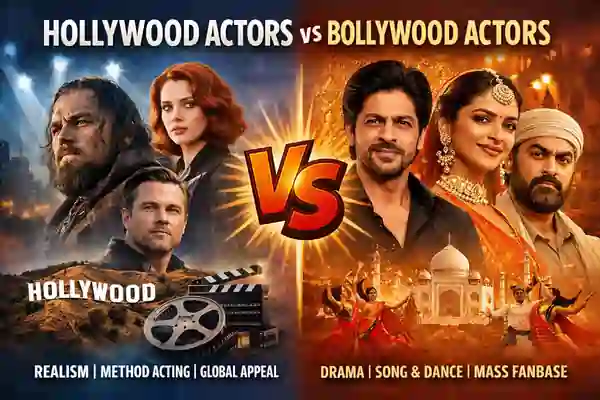
Hollywood Actors vs Bollywood Actors: A Deep Dive into Stardom, Craft, Culture, and Global Impact
The world of cinema is vast, diverse, and deeply influential. Among the most powerful film industries globally, Hollywood and Bollywood stand as two giants representing different cultures, storytelling traditions, acting philosophies, and audience expectations. While Hollywood, based in Los Angeles, USA, dominates the global box office and sets international technical benchmarks, Bollywood, the Hindi film industry based in Mumbai, India, commands unmatched emotional connect, musical storytelling, and mass appeal across South Asia and the diaspora.
Actors are the face of both industries. They carry the stories, emotions, and identities of their cultures onto the screen. Comparing Hollywood actors and Bollywood actors is not about determining who is better, but about understanding how training, performance style, stardom, audience expectations, budgets, scripts, and cultural roots shape their craft differently.
This comprehensive comparison explores how actors from both industries evolve, perform, and influence audiences worldwide.
1. Historical Evolution of Acting in Hollywood and Bollywood
Hollywood
Hollywood’s acting tradition is heavily influenced by theatre, realism, and method acting. From the early days of silent cinema to today’s CGI-heavy blockbusters, Hollywood actors have followed a journey shaped by institutions like The Actors Studio, Lee Strasberg Theatre Institute, and Juilliard School. Legends like Marlon Brando, Al Pacino, Robert De Niro, and Meryl Streep helped define intense character immersion.
Bollywood
Bollywood’s roots lie in theatre, mythology, classical arts, and melodrama. Early actors such as Raj Kapoor, Dilip Kumar, and Dev Anand shaped a performance style driven by expressive dialogue, emotional depth, and musical integration. Over time, actors like Amitabh Bachchan, Shah Rukh Khan, and Aamir Khan modernized the craft while retaining emotional storytelling.
Key Difference:
Hollywood evolved towards realism; Bollywood evolved towards emotion and drama.
2. Training and Acting Schools
Hollywood Actors
Most Hollywood actors undergo formal acting education:
- Method acting
- Voice and speech training
- Body movement and character study
- Script analysis and improvisation
Actors like Christian Bale, Joaquin Phoenix, and Daniel Day-Lewis are known for extreme preparation for roles.
Bollywood Actors
Earlier generations often entered through theatre or film families. Today, formal institutions like:
- FTII (Film and Television Institute of India)
- NSD (National School of Drama)
- Private acting schools (including modern academies)
have improved professional training. Actors like Nawazuddin Siddiqui, Irrfan Khan, and Pankaj Tripathi are products of theatre and formal training.
Key Difference:
Hollywood emphasizes institutional training; Bollywood is now rapidly adopting structured training.
3. Acting Style and Performance
Hollywood Style
- Subtle expressions
- Minimal dialogue, maximum realism
- Deep character immersion
- Focus on psychological authenticity
Example: Leonardo DiCaprio in The Revenant barely speaks but conveys intense emotion.
Bollywood Style
- Expressive dialogue delivery
- Emotional highs and dramatic arcs
- Integration with songs and dance
- Larger-than-life portrayal
Example: Shah Rukh Khan’s emotional performances in romantic dramas.
Key Difference:
Hollywood = understated realism
Bollywood = expressive emotional storytelling
4. Script and Character Importance
Hollywood scripts are often character-driven. The story revolves around character development. Actors may not be “heroes” but flawed individuals.
Bollywood scripts have traditionally been hero-centric, where the star image influences the story. However, this is changing with content-driven cinema.
5. Physical Transformation and Role Preparation
Hollywood actors are famous for drastic transformations:
- Christian Bale losing/gaining weight
- Chris Hemsworth’s superhero training
- Charlize Theron’s transformation in Monster
Bollywood actors now follow similar patterns:
- Aamir Khan in Dangal
- Ranveer Singh in Padmaavat
- Hrithik Roshan’s fitness regimes
6. Dance, Music, and Versatility
This is where Bollywood actors stand apart.
Bollywood actors must:
- Act
- Dance professionally
- Perform in song sequences
- Deliver dialogues dramatically
Hollywood actors rarely need dance skills unless the role demands it.
Key Difference:
Bollywood actors are often multi-talented performers; Hollywood actors are role-specialists.
7. Stardom and Fan Following
Bollywood actors enjoy god-like fandom. Fans celebrate film releases like festivals.
Hollywood actors are admired globally but maintain personal privacy and professional boundaries.
8. Global Reach and Market
Hollywood films release worldwide with massive marketing budgets. Actors gain global recognition.
Bollywood actors dominate in India, Middle East, Africa, and diaspora markets. With OTT platforms, their reach is expanding rapidly.
9. Pay Scale and Budgets
Hollywood actors command some of the highest salaries in the world due to billion-dollar franchises.
Bollywood actors earn less comparatively but are among the highest-paid in Asia.
10. Awards and Recognition
Hollywood actors compete in globally recognized awards like Oscars, Golden Globes, BAFTA.
Bollywood awards are popular but often seen as commercial. However, Indian actors are now receiving international recognition.
11. Language and Dialogue Delivery
Hollywood actors perform primarily in English with controlled accents.
Bollywood actors deliver dialogues in Hindi/Urdu with poetic emotion and powerful monologues.
12. Risk-Taking and Experimental Roles
Hollywood encourages experimentation and anti-hero roles.
Bollywood traditionally preserved star image but is now embracing experimental cinema.
13. Work Culture and Professionalism
Hollywood sets strict schedules, contracts, unions, and safety norms.
Bollywood has improved professionalism but still allows flexibility and star influence.
14. Influence on Society
Hollywood influences global pop culture, fashion, and ideology.
Bollywood influences traditions, festivals, romance, family values, and music.
15. OTT Era and Changing Landscape
Streaming platforms have blurred the lines. Bollywood actors now work in realistic, content-driven series. Hollywood actors explore diverse global themes.
Conclusion-Hollywood Actors vs Bollywood Actors
Hollywood actors and Bollywood actors represent two magnificent schools of performance shaped by culture, audience, and cinematic history. Hollywood actors are masters of realism, transformation, and subtlety. Bollywood actors are icons of emotion, versatility, and mass connection.
Today, the gap is narrowing. Bollywood is adopting realism; Hollywood is embracing diversity and music-driven storytelling. Ultimately, great acting transcends geography. Whether it is a silent tear in a Hollywood drama or an emotional monologue in a Bollywood romance, the goal remains the same — to move the audience.
Both industries continue to inspire millions, proving that cinema is a universal language spoken through the craft of actors.
Advertisement – Accounting Partner –Accutech , Publicity Partner- BDRINGESTA , Branding Partner – Ayuvista,Best Acting Classes Near me- MS Asian Film Academy , Supported by Nav Times News , Powered by MSasian Entertainment , Photography Partner- CK Photography , Hospitality Partner – Health Mark Food