
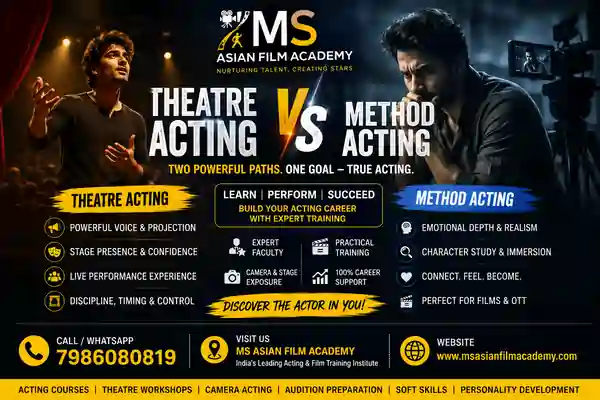
Theatre Acting vs Method Acting: Understanding the Real Difference in Performance Styles
Theatre Acting vs Method Acting- Acting is one of the most powerful forms of storytelling. From emotional stage performances to deeply immersive film roles, actors use different techniques to bring characters to life. Among the many acting styles practiced around the world, two of the most discussed and respected approaches are Theatre Acting and Method Acting.
While both aim to create believable performances, the techniques, preparation methods, emotional involvement, and execution differ greatly. Some actors thrive on the disciplined projection and timing required in theatre, while others completely immerse themselves into a character through method acting.
For aspiring actors, understanding these two approaches is essential before choosing the path that best suits their personality, career goals, and artistic strengths. Institutions like MS Asian Film Academy help students explore both traditional and modern acting techniques through professional training programs, workshops, and practical exposure.
In this blog, we will explore the complete difference between theatre acting and method acting, their origins, techniques, advantages, challenges, and which style works best for modern cinema and OTT platforms.
What is Theatre Acting?
Theatre acting is one of the oldest forms of acting, performed live on stage in front of an audience. It focuses heavily on voice control, body language, stage presence, timing, and emotional expression.
In theatre acting, there are no retakes. Actors must perform continuously and maintain consistency throughout the entire performance. Since the audience may be sitting far from the stage, expressions, movements, and dialogues are often larger and more dramatic compared to film acting.
Theatre acting teaches actors:
- Voice projection
- Physical control
- Stage discipline
- Timing and rhythm
- Audience engagement
- Character continuity
Many legendary actors began their careers in theatre because it builds a strong foundation in acting fundamentals.
What is Method Acting?
Method acting is a psychological acting technique where actors deeply immerse themselves into the emotional and mental state of a character. Instead of simply performing emotions, method actors attempt to genuinely feel them.
This acting style became globally popular through practitioners inspired by Konstantin Stanislavski and later developed by Lee Strasberg in Hollywood.
Method acting often involves:
- Emotional memory recall
- Real-life behavioral study
- Living like the character
- Internal emotional connection
- Deep psychological preparation
Actors using this technique may stay in character even outside the set to maintain emotional authenticity.
Famous examples of method actors include:
- Daniel Day-Lewis
- Al Pacino
- Heath Ledger
- Christian Bale
Origin of Theatre Acting
Theatre acting dates back thousands of years to ancient Greek and Roman civilizations. Traditional theatre forms later evolved in different cultures, including:
- Shakespearean theatre in England
- Broadway theatre in America
- Classical Indian theatre traditions
- Experimental and modern theatre
In India, theatre has played a major role in shaping legendary performers in cinema. Many successful Bollywood actors started with theatre training before entering films.
Origin of Method Acting
Method acting evolved from the teachings of Russian theatre practitioner Konstantin Stanislavski. His system focused on realistic emotional truth in performances.
Later, Lee Strasberg introduced and popularized method acting in Hollywood through the famous Actors Studio.
The technique revolutionized film acting by encouraging actors to emotionally live their characters instead of simply performing rehearsed expressions.
Major Differences Between Theatre Acting and Method Acting
1. Performance Environment
Theatre Acting
- Performed live on stage
- Audience watches continuously
- Requires louder dialogue delivery
- Bigger expressions and movements
Method Acting
- Mostly used in films and OTT content
- Camera captures subtle emotions
- Small facial expressions matter
- Focus on emotional realism
2. Emotional Approach
Theatre Acting
Actors perform emotions using trained techniques and rehearsed delivery.
Method Acting
Actors emotionally experience the feelings of the character internally.
3. Voice and Body Language
Theatre Acting
Requires:
- Strong voice projection
- Clear diction
- Controlled body movement
- Stage awareness
Method Acting
Focuses more on:
- Natural speech
- Subtle body language
- Realistic behavior
4. Audience Connection
Theatre Acting
The actor directly interacts with live audience energy.
Method Acting
The performance is designed for camera realism rather than audience interaction.
5. Rehearsal Process
Theatre Acting
Long rehearsals with group coordination and blocking.
Method Acting
Individual emotional preparation and character research.
Advantages of Theatre Acting
Theatre acting offers several benefits for aspiring actors:
Strong Acting Foundation
Theatre builds discipline, confidence, and technical acting skills.
Better Voice Control
Actors learn proper pronunciation, breathing, and projection.
Improved Confidence
Performing live in front of audiences reduces fear and nervousness.
Character Consistency
Actors learn how to sustain emotions for long durations.
Team Coordination
Theatre teaches collaboration and stage timing.
Many acting coaches believe theatre training creates stronger long-term performers.
Advantages of Method Acting
Method acting also offers unique advantages:
Highly Realistic Performances
Actors appear emotionally authentic on camera.
Strong Character Depth
Characters feel psychologically believable.
Emotional Connection
Audiences feel deeply connected to performances.
Powerful Film Presence
Method acting works exceptionally well in close-up cinematic scenes.
This style is especially effective in serious drama films, psychological roles, and emotional storytelling.
Challenges of Theatre Acting
Despite its strengths, theatre acting can be demanding.
Physical Exhaustion
Live performances require continuous energy.
No Retakes
Mistakes cannot be edited.
Larger Expressions Needed
Subtle emotions may not work well on stage.
Long Rehearsal Hours
Actors spend weeks or months preparing productions.
Challenges of Method Acting
Method acting can also become emotionally difficult.
Emotional Stress
Deep immersion may affect mental well-being.
Character Attachment
Some actors struggle to disconnect from intense roles.
Time-Consuming Preparation
Research and emotional preparation can take months.
Psychological Pressure
Extreme emotional involvement can become mentally exhausting.
Because of this, many modern acting coaches recommend balanced emotional techniques rather than extreme immersion.
Which Acting Style is Better?
The truth is that neither style is universally better.
The best acting style depends on:
- The actor’s personality
- Medium of performance
- Character requirements
- Career goals
- Emotional comfort level
Theatre Acting is Better For:
- Building acting fundamentals
- Improving confidence
- Stage performances
- Voice and expression training
Method Acting is Better For:
- Realistic film performances
- Emotional cinematic roles
- Psychological characters
- OTT and close-up acting
Today, many successful actors combine both techniques to create balanced performances.
Theatre Acting in Modern Cinema
Modern cinema still values theatre-trained actors because they bring strong discipline and technical mastery.
Many globally respected actors with theatre backgrounds deliver exceptional film performances because they understand:
- Timing
- Character structure
- Emotional rhythm
- Dialogue delivery
Even in OTT platforms and web series, theatre training continues to be highly respected.
Method Acting in Bollywood and Hollywood
Method acting has become extremely popular in both Hollywood and Bollywood.
Actors often:
- Gain or lose weight for roles
- Study real-life personalities
- Change accents and behaviors
- Remain in character during shooting
This dedication often creates unforgettable performances that audiences admire deeply.
However, modern filmmakers also prefer actors who can maintain emotional realism without damaging mental health.
Why Professional Acting Training Matters
Many beginners assume acting is purely natural talent, but professional training plays a major role in developing successful performers.
Professional acting academies help students learn:
- Camera acting
- Theatre fundamentals
- Method techniques
- Voice training
- Emotional control
- Audition preparation
- Script analysis
MS Asian Film Academy is among the institutions helping aspiring actors understand different acting approaches through practical workshops, performance exercises, and industry-oriented learning.
Students gain exposure to both stage and camera performance techniques, helping them discover their unique acting strengths.
Can an Actor Learn Both Styles?
Absolutely.
In fact, many professional actors today use a hybrid approach.
For example:
- Theatre techniques help with voice and discipline.
- Method techniques help with emotional authenticity.
Combining both styles allows actors to become versatile performers capable of working in:
- Films
- OTT platforms
- Advertisements
- Theatre productions
- Television
- Web series
Versatility is one of the biggest strengths in today’s entertainment industry.
How Beginners Should Start Acting Training
If you are new to acting, starting with theatre basics is often recommended because it builds:
- Confidence
- Discipline
- Stage comfort
- Communication skills
After building fundamentals, actors can gradually explore method acting and emotional realism for camera performances.
Joining professional acting workshops and academies can accelerate learning and provide practical exposure.
Future of Acting in the OTT Era
The rise of OTT platforms has changed acting styles significantly.
Today’s audiences prefer:
- Natural dialogue delivery
- Realistic emotions
- Relatable performances
- Character-driven storytelling
This is why method-inspired realistic acting has become increasingly popular.
However, theatre training remains essential because it develops strong technical foundations that many self-trained actors lack.
The future belongs to actors who can balance:
- Emotional truth
- Technical control
- Screen presence
- Versatility
Conclusion -Theatre Acting vs Method Acting
The debate between theatre acting and method acting is not about choosing one over the other. Both styles offer valuable skills that contribute to becoming a complete actor.
Theatre acting develops discipline, confidence, projection, and stage mastery. Method acting builds emotional depth, realism, and psychological connection with characters.
The most successful actors often combine the strengths of both approaches to create memorable performances.
For aspiring performers, proper training is essential to understand these techniques professionally. Institutions like MS Asian Film Academy provide opportunities for students to explore multiple acting methods and build careers in film, theatre, television, and digital entertainment.
In the end, great acting is not about following one rigid style. It is about truth, emotion, connection, and the ability to make audiences believe in the character completely.
FAQs -Theatre Acting vs Method Acting
What is the main difference between theatre acting and method acting?
Theatre acting focuses on live stage performance, voice projection, and expressive delivery, while method acting focuses on emotionally becoming the character for realistic screen performances.
Is method acting better than theatre acting?
Not necessarily. Both styles have unique strengths. Theatre acting builds technical skills, while method acting enhances emotional realism.
Which acting style is best for films?
Method acting is often preferred for realistic film performances, but theatre-trained actors also perform exceptionally well in cinema.
Can theatre actors become film actors?
Yes. Many successful film actors started with theatre training because it provides strong acting fundamentals.
Is method acting emotionally difficult?
Sometimes. Deep emotional immersion can become mentally exhausting if not handled carefully.
Why is theatre training important for beginners?
Theatre improves confidence, communication, body language, voice control, and stage discipline.
Can actors combine both acting styles?
Yes. Most modern actors combine theatre techniques and method acting for balanced performances.
Where can beginners learn professional acting?
Aspiring actors can learn through workshops, theatre groups, and professional institutions like MS Asian Film Academy that offer structured acting training programs.
Supported by Nav Times News, Powered by MSasian Entertainment , Supported by MSAFA