Acting vs Filmmaking — Which Career is Right for You? (Complete Career Guide for Future Creators)
Want to work in films but confused between acting and filmmaking?
You’re not alone.
Thousands of students dream of entering cinema, OTT platforms, web series, advertising, and digital entertainment—but one question stops them:
Should I become an actor… or should I become a filmmaker?
At first glance, both careers look connected. Both belong to the entertainment industry. Both demand creativity. Both can lead to recognition, exciting projects, and long-term opportunities.
But the reality is very different.
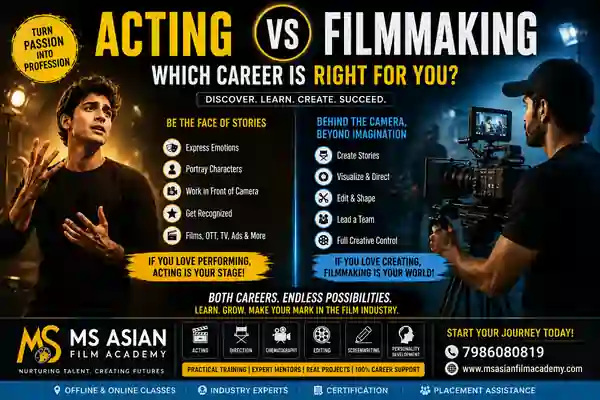
An actor brings stories to life on screen.
A filmmaker builds the world behind the camera.
Choosing the wrong path can leave talented people frustrated. Choosing the right one can transform passion into a meaningful career.
This guide will help you understand the real difference between acting and filmmaking, compare career opportunities, income potential, required skills, learning paths, and help you discover which path matches your personality.
For students looking for structured professional training, institutions like MS Asian Film Academy provide specialized programs in Acting, Filmmaking, Direction, Editing, Cinematography, Writing, and practical industry-oriented learning.
Understanding Acting — The Art of Becoming Someone Else
Acting is the craft of portraying emotions, characters, and stories in front of an audience or camera.
Actors don’t simply memorize dialogues.
They interpret characters.
They communicate emotion.
They make audiences believe.
Modern acting careers go far beyond movies.
Today actors work in:
- Films
- OTT platforms
- Television
- Web series
- Commercial ads
- Brand collaborations
- Theatre
- Voice acting
- YouTube content
- Corporate storytelling
Professional acting training often focuses on:
- Expression and body language
- Voice modulation
- Character building
- Improvisation
- Camera confidence
- Audition preparation
- Scene execution
- Emotional intelligence
According to course information published by MSAFA, practical acting exposure includes performance exercises, audition training, showreel preparation, and industry-focused learning approaches.
Acting May Be Right For You If:
✓ You enjoy performing
✓ You love emotions and storytelling
✓ You feel energized in front of people
✓ You naturally observe human behavior
✓ You want visibility and public recognition
✓ You enjoy becoming different characters
Understanding Filmmaking — The Art of Creating Entire Worlds
If actors are the face of a story…
Filmmakers are the architects behind it.
Filmmaking combines creativity, leadership, technology, planning, and storytelling.
Filmmakers decide:
- What story gets told
- How scenes look
- What emotions are created
- Camera movement
- Editing style
- Sound design
- Production planning
Filmmaking includes multiple specializations:
Direction
Leading the creative vision.
Screenwriting
Creating characters and stories.
Cinematography
Capturing visual emotion.
Editing
Building rhythm and narrative.
Production
Managing execution.
Sound Design
Creating immersive experiences.
Creative Development
Transforming ideas into screen experiences.
Professional filmmaking programs often combine pre-production, storytelling, direction, and technical execution training.
Filmmaking May Be Right For You If:
✓ You enjoy leading projects
✓ You love creating ideas
✓ You think visually
✓ You prefer strategy over spotlight
✓ You enjoy solving creative problems
✓ You like collaborating with teams
Acting vs Filmmaking — The Real Comparison
| Career Factor | Acting | Filmmaking |
| Primary Focus | Performance | Creation |
| Work Position | Front of Camera | Behind Camera |
| Core Skill | Emotional Expression | Story Execution |
| Career Style | Personal Branding | Team Leadership |
| Visibility | High | Medium |
| Creative Control | Moderate | Very High |
| Learning Curve | Continuous | Broad Technical Growth |
| Project Ownership | Limited | Significant |
| Networking Importance | Very High | Very High |
Neither career is better.
They simply suit different personalities.
Skill Requirements: What Success Actually Demands
To Succeed in Acting
You need:
- Confidence
- Emotional range
- Discipline
- Patience
- Audition readiness
- Camera awareness
- Communication
Success rarely happens overnight.
Actors continuously train.
To Succeed in Filmmaking
You need:
- Storytelling ability
- Decision making
- Leadership
- Technical understanding
- Visual imagination
- Collaboration
- Project management
Filmmakers often build stronger long-term creative ownership.
Career Opportunities in 2026 and Beyond
The entertainment industry is changing rapidly.
Traditional cinema is no longer the only destination.
Today opportunities exist across:
- OTT content
- YouTube Originals
- Brand films
- Documentary production
- Social media content
- Digital storytelling
- Independent cinema
- Regional entertainment
- Commercial production
Acting Opportunities
- Actor
- Child Artist
- Commercial Artist
- OTT Performer
- Theatre Artist
- Voice Artist
- Influencer
Filmmaking Opportunities
- Director
- Assistant Director
- Editor
- Cinematographer
- Screenwriter
- Content Producer
- Production Manager
Students increasingly choose structured learning environments that combine practical work, workshops, and portfolio building rather than theory-only education.
The Biggest Myths That Confuse Beginners
Myth 1: Acting is Easier
Reality:
Professional acting requires intense emotional and technical discipline.
Myth 2: Filmmaking Means Only Directing
Reality:
Filmmaking includes dozens of career paths.
Myth 3: You Must Choose Only One
Reality:
Many professionals learn both.
Actors often understand filmmaking.
Filmmakers often study performance.
Myth 4: Talent Alone Is Enough
Reality:
Training, consistency, networking, and execution matter.
Should You Learn Acting and Filmmaking Together?
For many beginners:
The answer is yes.
Understanding both sides creates stronger professionals.
Actors who understand cameras perform better.
Filmmakers who understand actors direct better.
Institutes such as MS Asian Film Academy offer training across Acting, Direction, Editing, Writing, Cinematography, Film Making, Personality Development, and related disciplines designed around practical learning environments.
Benefits of learning both:
- Better industry understanding
- More career flexibility
- Stronger communication
- Greater creative confidence
- Wider opportunities
How to Decide — A Simple Self-Test
Answer honestly.
Choose Acting if:
- You imagine yourself on screen
- You enjoy performing
- You seek audience connection
- You love expressing emotions
Choose Filmmaking if:
- You think in stories
- You enjoy planning
- You love directing ideas
- You prefer building experiences
Choose Both if:
- You enjoy storytelling from every angle.
How Professional Training Can Accelerate Your Journey
Most beginners make one common mistake:
They wait.
They keep thinking.
They delay starting.
But creative careers grow through action.
Professional training can help by providing:
- Structured curriculum
- Industry mentors
- Real projects
- Workshops
- Portfolio building
- Performance practice
- Collaborative environments
MS Asian Film Academy presents itself as a career-focused institute offering practical programs across acting, filmmaking, writing, editing, cinematography, direction, and personality development with online and offline learning formats.
Learn more here:
MS Asian Film Academy Official Website
Final Thoughts – Acting vs Filmmaking — Which Career is Right for You?
Choosing between Acting and Filmmaking isn’t about selecting the more glamorous career.
It’s about choosing where your creativity comes alive.
If you love performing emotions, step in front of the camera.
If you love building worlds, step behind it.
And if your heart pulls both ways—explore both.
Cinema has room for performers.
Cinema has room for creators.
The most important thing is not waiting for the perfect moment.
Start learning. Start creating. Start showing up.
Your first scene—or your first film—might begin today.
Frequently Asked Questions (FAQs)
1. Is acting better than filmmaking?
Neither is better. Acting focuses on performance while filmmaking focuses on creating and directing stories.
2. Can I learn acting and filmmaking together?
Yes. Learning both helps develop stronger creative understanding and broader opportunities.
3. Is filmmaking a good career in 2026?
Yes. Growth in OTT, digital media, branded content, and independent production continues expanding opportunities.
4. Do actors need formal training?
Training improves performance, confidence, auditions, and professional readiness.
5. Can filmmakers become actors?
Yes. Many professionals explore both paths.
6. Which career has more creative control?
Filmmaking generally offers greater creative ownership.
7. How long does it take to learn acting?
Learning timelines vary, but practical training and regular performance accelerate growth.
8. What should beginners choose first?
Start with the path that naturally excites you more—performing or creating.
9. Are there online and offline learning options?
Many institutes now offer hybrid formats with practical exposure and workshops.
10. Where can I explore acting and filmmaking courses?
You can explore programs through MS Asian Film Academy which offers courses across acting and filmmaking disciplines.
Supported by Nav Times News, Powered by MSasian Entertainment , Supported by MSAFA