
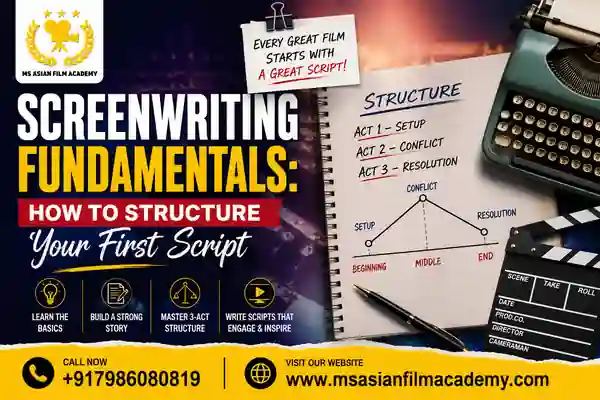
Screenwriting Fundamentals: How to Structure Your First Script
Screenwriting Fundamentals -There’s a moment every beginner writer hits — you’ve got a great scene in your head, maybe even a killer line of dialogue, but no idea how to turn that spark into an actual script that holds together for ninety pages. If that’s where you’re stuck right now, you’re not alone. Almost every working screenwriter, director, and actor has stared at a blank page wondering where to even begin.
The good news is that screenplay structure isn’t some mysterious talent you’re born with. It’s a craft, built on patterns that have worked for decades of storytelling — and once you understand the bones of a script, filling in the flesh becomes far less intimidating. This guide walks you through exactly how to structure your first script, step by step, whether you’re writing for a short film, a feature, or simply trying to understand story construction because you’re training as an actor.
Why Structure Matters More Than “Good Ideas”
New writers often assume that a great story idea is enough. It isn’t. A brilliant concept with no structure feels like a car with a powerful engine and no steering wheel — it might move, but it won’t get anywhere on purpose.
Structure gives your audience (and your characters) a reason to keep watching. It creates rhythm: tension building, releasing, building again. Without it, even the most original premise collapses into a string of disconnected scenes. This is exactly why structure is taught as a foundational subject in serious filmmaking and acting programs — understanding how a scene is built is what allows an actor to perform it with intention, and what allows a director to shoot it with purpose. (Screenwriting Fundamentals)
The Three-Act Structure: Your Foundation
Nearly every produced screenplay — from small festival shorts to major studio releases — is built on some version of the three-act structure. It isn’t a rigid formula so much as a map of how human beings naturally respond to storytelling.
Act One: Setup (roughly the first 25% of your script) This is where you introduce your world, your protagonist, and the ordinary life they’re about to lose. The audience needs to know who they’re rooting for and what’s at stake before the story disrupts everything. Act One ends with what’s often called the “inciting incident” — the event that kicks the real story into motion. Think of it as the moment there’s no turning back.
Act Two: Confrontation (the middle 50%) This is the longest and hardest part to write, and it’s where most beginner scripts fall apart. Your protagonist is now chasing a goal, but obstacles keep piling up — external conflict, internal doubt, relationships that complicate things further. Around the midpoint, something should shift the stakes even higher. By the end of Act Two, your character usually hits their lowest point, the moment where success feels impossible. (Screenwriting Fundamentals)
Act Three: Resolution (the final 25%) Everything your character has learned or become gets tested in the climax. This is where the central conflict resolves — for better or worse — and the story answers the question it posed in Act One. A strong Act Three doesn’t just wrap up the plot; it shows how the protagonist has changed.
Understanding these three acts gives you a skeleton. Once you can identify where you are in the structure, writing individual scenes becomes far less overwhelming.
Building Blocks Inside the Structure
1. A Protagonist Who Wants Something
Every strong script starts with a character who has a clear, specific desire. It doesn’t need to be dramatic — it could be as simple as wanting to be believed, or wanting to leave a small town. What matters is that the want is concrete enough to drive action for ninety-plus pages. (Screenwriting Fundamentals)
2. Conflict on Every Level
Conflict isn’t just villains and car chases. It can be internal (a character fighting their own fear), interpersonal (two people who want opposite things), or societal (a character up against a system). The best scripts layer multiple types of conflict so tension never feels one-note.
3. Stakes That Actually Matter
Ask yourself constantly: what happens if my protagonist fails? If the honest answer is “not much,” your stakes are too low. Raise them until the audience genuinely worries about the outcome.
4. A Character Arc
Plot is what happens. Character arc is who your protagonist becomes because of what happens. The two should be inseparable — external events should force internal change, and internal change should drive new decisions that move the plot forward.
Formatting: The Technical Side Beginners Skip
A script isn’t a short story. Screenplays follow an industry-standard format for a reason — it lets directors, producers, and actors read a page and instantly picture pacing, tone, and timing. One formatted page roughly equals one minute of screen time, which is why format discipline matters so much. (Screenwriting Fundamentals)
A few basics to get right from day one:
- Use 12-point Courier font, which keeps consistent page-to-minute timing
- Scene headings (INT./EXT., location, time of day) should be clear and consistent
- Action lines stay in present tense and describe only what’s visible on screen
- Dialogue is centered under the character’s name, written the way people actually speak
- Avoid camera directions unless absolutely necessary — that’s the director’s job, not the writer’s
Free and paid screenwriting software like Final Draft, Celtx, or WriterDuet will auto-format most of this for you, so you can focus on story rather than margins.
Writing Dialogue That Doesn’t Sound Like Writing
Dialogue is where a lot of first drafts either come alive or fall flat. The trap most beginners fall into is writing dialogue that sounds like an essay — characters explaining exactly what they mean, in complete, polite sentences. Real people rarely talk that way.
A few habits worth building early:
Let characters want different things in a scene. Two people simply agreeing with each other for three pages is a scene with no engine. Even a quiet conversation between friends works better when there’s a small mismatch in what each person is after — one wants comfort, the other wants honesty, for instance.
Cut the greetings and small talk. Unless it’s doing character work, “Hi, how are you, good and you” wastes space. Enter scenes late and leave them early.
Read it out loud. This single habit catches more awkward dialogue than any amount of silent rereading. If a line trips your tongue, it’ll trip an actor’s too.
Give each character a distinct voice. Cover the character names on a page of dialogue and see if you can still tell who’s speaking based on word choice and rhythm alone. If everyone sounds the same, it usually means everyone is a slightly different version of the writer’s own voice.
Dialogue improves fastest through practice and outside feedback — which is exactly why table reads and scene work with other actors and writers is such a core part of proper training. You can rewrite a scene alone twenty times and still miss what becomes obvious the moment it’s spoken aloud in a room. (Screenwriting Fundamentals )
Outlining Before You Write
Not every writer outlines the same way, and there’s no single correct method — but skipping outlining entirely is one of the fastest routes to a script that loses direction around page 40. A workable approach for beginners is the beat sheet: a loose list of 15–20 major story beats (the inciting incident, key turning points, the midpoint, the low point, the climax) written in a sentence or two each, before a single page of actual script gets written.
Think of the beat sheet as scaffolding, not a cage. It’s there so you always know where a scene sits within the larger structure, which makes it far easier to catch problems early — a saggy middle, a rushed ending, a subplot that never pays off — instead of discovering them 90 pages in in an unstructured pile of scenes.
Some writers prefer index cards, physically laid out and rearranged on a wall or table. Others use a simple spreadsheet or a notes app. The method matters less than the habit of knowing, roughly, where the story is going before you commit to prose.
Revising With Structure in Mind
Once a first draft exists, the real work of screenwriting begins. Revision isn’t about fixing typos — it’s about testing structure against the finished draft and being honest about where it sags.
A useful pass-through checklist:
- Does the inciting incident happen early enough to hook a reader?
- Does every scene either advance the plot or reveal character — ideally both?
- Is the midpoint shift strong enough to raise the stakes noticeably?
- Does the protagonist’s lowest point actually feel low, or does it read as a minor setback?
- Does the ending pay off the specific question the story raised in Act One?
If a scene doesn’t earn its place against these questions, it’s usually a candidate for cutting, no matter how well-written the individual lines are. This kind of structural editing is a skill on its own, separate from prose-level polishing, and it’s one that improves dramatically with mentorship and repetition rather than instinct alone.
Common Mistakes First-Time Screenwriters Make
Starting too early. Many first drafts spend ten pages establishing “normal life” before anything interesting happens. Trim it. Enter the story as close to the inciting incident as you reasonably can.
Explaining instead of showing. If a character has to say “I’m angry because my father left when I was seven,” that’s usually a sign the emotion should be shown through behavior instead of stated outright.
Flat secondary characters. Every character, even minor ones, should feel like they have a life happening off-page. Give them one distinct trait or contradiction and they instantly become memorable.
Skipping the rewrite. No first draft is the final draft. Structure especially benefits from stepping away, rereading with fresh eyes, and asking whether every scene earns its place.
Why Screenwriting Knowledge Makes You a Better Actor
Here’s something aspiring performers often underestimate: understanding how a script is built makes you a sharper actor. When you know why a scene exists structurally — what it’s setting up, what it’s paying off, where your character sits emotionally within the larger arc — your choices on camera or on stage stop being guesswork and start being intentional.
This is exactly why script analysis and story structure are woven into serious actor training rather than treated as a separate subject for writers only. An actor who understands structure can identify their character’s want in a scene, locate the obstacle, and play the conflict with precision instead of generic emotion. It’s one of the reasons practical, industry-connected training matters so much for anyone serious about performance — whether the goal is film, television, or theatre.
Turning Script Knowledge Into a Career
Reading about structure is a start, but craft is built through practice, feedback, and mentorship from people who’ve actually worked in the industry. Whether your goal is to write, act, direct, or all three, structured training accelerates the learning curve in a way that self-teaching alone rarely can.
If you’re based in Punjab or considering relocating for serious training, MS Asian Film Academy offers hands-on, industry-oriented programs designed around exactly this kind of practical understanding — where script analysis, performance, and filmmaking craft are taught together rather than in isolation.
For those specifically drawn to performance, the acting course at MSAFA builds a strong foundation in scene study, character work, and script interpretation, guided by trainers with real industry experience. Students searching for acting classes near me in Chandigarh consistently point to MSAFA’s practical, camera-ready training style as a key reason they chose the institute over purely theoretical drama schools.
If storytelling itself is your real interest — building worlds, not just performing in them — the film direction course and filmmaking course go deeper into structure, screenplay development, and on-set craft, giving writers a direct path from page to screen. And for those exploring the visual and commercial side of the industry, the modelling course rounds out MSAFA’s multi-vertical approach to performing arts education.
MSAFA has built a reputation as one of the top acting schools in India, largely because training doesn’t stop at the classroom door. Through its connected production house, MS Groupe, students get real exposure to sets, scripts, and productions — the kind of experience that separates a best acting school in India from one that only teaches theory. That production pipeline is also a major reason MSAFA is able to offer 100% placement support, connecting trained students directly with opportunities in film, television, and theatre.
How Structure Applies Beyond Film — Theatre and Live Performance
While this guide focuses on screenplays, the same structural instincts apply almost directly to stage writing and performance. A play still needs a protagonist with a clear want, escalating obstacles, and a resolution that earns its ending — the format simply changes to accommodate live staging rather than cuts and camera coverage.
This is one reason why students who train in both theatre classes and screen-focused acting tend to develop a more complete understanding of story than those who specialize immediately. Stage work demands a different kind of stamina and continuity — an actor has to sustain a character’s arc across an unbroken performance rather than in short filmed takes — while screen work demands precision in smaller, more fragmented moments. Understanding structure helps with both, because the underlying question is always the same: what does this character want right now, and what’s standing in the way?
Institutes that combine acting, direction, and production training under one roof — rather than isolating each discipline — tend to produce performers who understand story from every angle: as a writer would build it, as a director would shoot or stage it, and as a fellow actor would play against it.
A Quick Practice Exercise (Screenwriting Fundamentals)
Before you sit down to write a full script, try this: take a film or show you know well and break it into its three acts on paper. Mark the inciting incident, the midpoint shift, and the low point before the climax. Doing this with stories you already love trains your eye to spot structure automatically — and that instinct is what makes writing your own first script feel far less like guesswork.
Frequently Asked Questions (Screenwriting Fundamentals)
How long should my first screenplay be? A feature-length script typically runs 90–120 pages, with one page equaling roughly one minute of screen time. First-time writers often find it easier to start with a short script of 5–15 pages before attempting a full feature.
Do I need expensive software to write a screenplay? No. Free tools like Celtx or the free tier of WriterDuet handle industry-standard formatting without cost. What matters far more than software is understanding structure and character.
Is screenwriting knowledge useful for actors, not just writers? Yes, significantly. Actors who understand story structure and scene function make stronger, more specific performance choices, which is why script analysis is a core part of serious acting training rather than an optional extra.
Where can I get practical, industry-connected training in Chandigarh? MS Asian Film Academy offers acting, direction, and filmmaking courses in Chandigarh with direct exposure to real productions through its affiliated production house, MS Groupe, along with placement support for serious students.
Ready to Take the Next Step?
Understanding structure is the first real skill of a working screenwriter or actor — but reading about it will only take you so far. Real growth happens in a classroom with mentors who’ve worked on real sets, alongside peers who push you to get better.
If you’re searching for acting classes, a serious drama school, or hands-on theatre classes in Chandigarh, MS Asian Film Academy is currently accepting new students. Explore the full range of programs at msasianfilmacademy.com/courses, or reach out directly to speak with the admissions team.
📞 Call or WhatsApp: +91 7986080819 🌐 Visit: www.msasianfilmacademy.com
Your first script — and your first real step into the industry — starts with understanding the structure behind the story.
Screenwriting Fundamentals –Supported by Nav Times News, Powered by MSasian Entertainment , Supported by MSAFA