
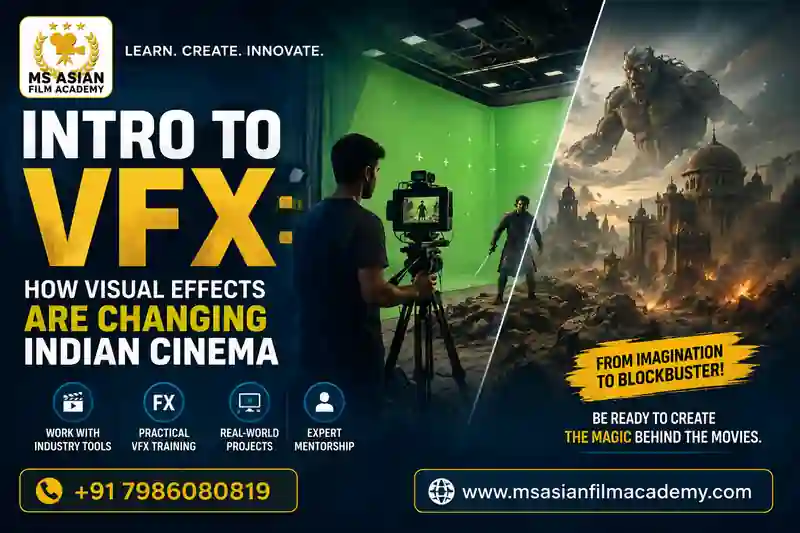
Intro to VFX: How Visual Effects Are Changing Indian Cinema
Remember the first time you watched a Baahubali waterfall crash into a valley, or saw Hanuman soar across a temple courtyard in a way that felt completely real? Chances are you didn’t stop to ask “how did they do that.” You just believed it. That’s the quiet power of visual effects, or VFX, and it has completely rewritten what Indian cinema can dream up on screen.
For decades, Bollywood and regional film industries leaned on practical stunts, painted backdrops, and clever camera tricks to create spectacle. Today, VFX studios in Mumbai, Hyderabad, Chennai, and even Chandigarh are working on projects that rival Hollywood budgets and, in several cases, actual Hollywood output. If you’re someone who dreams of working in Indian films, whether as an actor, director, or technician, understanding this shift matters more than you might think.
What Exactly Is VFX, and Why Should Aspiring Actors Care
Visual effects refer to any imagery created, altered, or enhanced digitally, usually after filming has wrapped, that couldn’t be captured practically during the actual shoot. This is different from special effects, which happen live on set using props, prosthetics, or pyrotechnics. VFX lives in post-production, built frame by frame using software and enormous computing power.
Now here’s the part most acting aspirants overlook: VFX doesn’t replace actors, it amplifies them. A performer standing in front of a green screen still has to convey fear, wonder, or grief convincingly, because the emotional core of a scene never comes from the digital background. It comes from the face and body of the person delivering the performance. Directors today actively look for actors who can act opposite nothing, imagining a dragon, a spaceship, or a collapsing building that will only exist once the VFX team finishes their work months later.
This is exactly why serious acting training now includes exposure to green screen performance, understanding continuity for VFX shots, and learning to take direction without relying on a fully dressed set. Students who train at a proper <a href=”https://msasianfilmacademy.com/acting-course/”>acting course</a> get a real head start here, because studios are increasingly casting people who already understand this workflow.
A Quick Look Back: VFX Before the Digital Boom
Indian cinema’s relationship with visual trickery goes back much further than most people realize. Films from the 1950s and 60s used double exposure, matte paintings, and miniature models to create mythological spectacles and fantasy sequences. Think of the early depictions of gods descending from the heavens or demons transforming mid-scene. It was resourceful, often manual, and surprisingly effective for its time.
The real shift began in the late 1990s and early 2000s, when Indian filmmakers started importing digital compositing tools and hiring or training artists in computer-generated imagery. Films started experimenting cautiously at first, small effects here and there, before studios realized audiences were hungry for bigger, bolder visuals.
The Turning Point: Big-Budget Films That Changed the Game
A handful of films acted as genuine turning points for the Indian VFX industry.
The Baahubali franchise is probably the most cited example, and for good reason. It proved that Indian studios could build entire fantastical kingdoms, staged battles with thousands of digital soldiers, and waterfalls that looked completely convincing, all without a Hollywood-sized budget by international standards. The success of these films pushed producers across languages, not just Telugu cinema, to take VFX seriously as a storytelling tool rather than an occasional gimmick.
Around the same period, superhero and fantasy-adjacent Bollywood films began investing heavily in digital de-aging, crowd replication, and environment building. Period dramas started using VFX to recreate historical cities and battle sequences that would be impossible or prohibitively expensive to stage practically. Even romantic dramas and family films began quietly using VFX for weather effects, set extensions, and cleanup work that audiences never consciously notice but that make scenes feel polished and complete.
Homegrown VFX Studios Making Global Noise
One of the most encouraging developments for Indian creative professionals is the rise of domestic VFX houses that now compete for international projects. Studios based in India have contributed work to major global franchises, handling everything from creature design to complex crowd simulations. This matters for two reasons.
First, it means Indian technicians, many of whom started as film school graduates, are gaining recognition on a world stage. Second, and more relevant if you’re considering a career in entertainment, it means the ecosystem around filmmaking in India has grown far beyond just acting and directing. There are now stable, well-paying career paths in rotoscoping, compositing, 3D modeling, motion capture supervision, and effects animation, all feeding directly into the same productions that need trained actors and directors.
This is one reason film schools increasingly build VFX awareness into broader coursework. If you’re studying <a href=”https://msasianfilmacademy.com/film-making-course/”>filmmaking</a> or exploring <a href=”https://msasianfilmacademy.com/film-direction-course/”>film direction</a>, understanding how VFX pipelines work isn’t optional anymore, it’s part of being employable on a modern set.
How VFX Is Reshaping What Stories Get Told
Before affordable VFX tools, Indian filmmakers largely stayed within genres that were cheap to produce realistically: family dramas, romances, comedies, and grounded thrillers. Big mythological or fantasy stories existed, but they were rare and often looked dated even at release.
Now, VFX has opened the door to genres that were previously considered financially risky. Science fiction, superhero narratives, large-scale historical epics, and mythological retellings with genuinely convincing visuals are being greenlit more frequently. Regional cinema, particularly in South India, has led much of this charge, but Bollywood and Punjabi cinema are catching up quickly.
For actors and directors, this means a wider range of roles and story types to work with. A performer trained only in naturalistic, dialogue-heavy acting may find themselves underprepared for a set with motion capture suits, digital stand-ins, or entirely green-screened environments. This is part of why practical, updated training matters so much right now.
The Skills Gap: What Film Schools Need to Teach Today
Here’s an honest truth the industry doesn’t always say out loud: many acting and filmmaking programs across India still teach as though it’s 2005. Camera blocking, lighting basics, and traditional scene work remain essential, no argument there, but they’re incomplete without context on how modern productions actually operate.
A well-rounded acting or direction program today should cover:
- How to perform convincingly against green or blue screen backgrounds
- Understanding basic VFX terminology so actors can take direction efficiently on set
- How lighting continuity works when practical and digital elements need to match later
- Awareness of pre-visualization, where directors plan VFX-heavy scenes using rough digital mockups before filming begins
- Basic knowledge of how sound design and <a href=”https://msasianfilmacademy.com/courses/”>other filmmaking disciplines</a> intersect with visual effects in post-production
Students who get this exposure early are simply more prepared when they step onto a professional set, whether that’s a regional film, a web series, or a big-budget theatrical release.
VFX and the Rise of Regional and Independent Cinema
It’s not just the big studios benefiting. Falling costs of VFX software and increasing numbers of trained freelance artists mean even smaller, independent productions can now afford modest but effective visual enhancements. A low-budget Punjabi film can clean up a background, add subtle weather effects, or extend a set digitally without needing a Baahubali-sized budget.
This democratization matters for aspiring filmmakers and actors based outside the traditional Mumbai or Hyderabad hubs. If you’re training in a city like Chandigarh, you’re not shut out of these opportunities. Regional production houses are increasingly plugged into the same VFX talent pools and software pipelines as national studios, meaning strong training locally can absolutely translate into national or even international work.
What This Means If You’re Considering an Acting or Filmmaking Career
If you’re weighing whether to pursue formal training, the VFX boom is worth factoring into your decision for a few practical reasons.
Productions today expect actors who understand set etiquette around VFX shoots, meaning less hand-holding needed and more confidence in front of the camera. Directors and cinematographers benefit enormously from understanding VFX planning during pre-production, since it directly affects budgeting, shot lists, and shooting schedules. And frankly, working knowledge of how VFX integrates with performance and direction makes you a more versatile, hireable professional in a competitive industry.
This is exactly the gap that structured training aims to close. Programs that combine strong <a href=”https://msasianfilmacademy.com/acting-course/”>acting classes</a> with modern production awareness give students a genuine edge, rather than leaving them to figure out set technology on their first professional job.
Choosing the Right Training Ground
Chandigarh has quietly become a hub for serious acting and filmmaking education in North India, and if you’re searching for acting classes near me in Chandigarh, it’s worth looking closely at what a program actually offers beyond the basics.
A strong drama school or theatre classes program should build your foundation in voice, movement, and emotional range, since none of that changes regardless of how advanced VFX gets. But increasingly, the best acting school in India and the top acting school in India are the ones layering in awareness of digital production realities alongside classical training. Look for institutes offering diverse coursework, including <a href=”https://msasianfilmacademy.com/film-direction-course/”>film direction</a>, <a href=”https://msasianfilmacademy.com/modelling-course/”>modelling</a>, and hands-on filmmaking exposure, not just isolated acting workshops.
Placement support matters too. Training that comes with 100% placement assistance means your investment in classes isn’t just theoretical, it’s connected to actual industry entry points once you graduate.
The Road Ahead for VFX in India
Industry estimates consistently point to continued growth in India’s animation and VFX sector, driven by both domestic big-budget productions and international outsourcing work. As artificial intelligence tools begin assisting with rotoscoping, de-aging, and rendering speed, the barrier to producing convincing visual effects will likely keep dropping, opening the door to even more ambitious regional and independent storytelling.
For anyone stepping into the entertainment industry now, whether in front of the camera or behind it, this is genuinely one of the more exciting times to start. The tools are more accessible, the opportunities span far beyond just Mumbai, and the demand for well-rounded, camera-ready, production-savvy talent has never been higher.
Ready to Start Your Journey?
Visual effects have changed what Indian cinema can imagine, but they haven’t changed what makes a performance unforgettable, that still comes down to training, discipline, and genuine craft. If you’re ready to build real skills for a modern film industry, explore our <a href=”https://msasianfilmacademy.com/courses/”>full range of courses</a> at MS Asian Film Academy, or connect with our production arm at <a href=”https://msgroupe.online/”>MS Groupe</a> to see how training and industry opportunity come together.
Have questions about acting classes, drama school programs, or theatre classes in Chandigarh? Call us directly at <a href=”tel:+917986080819″>+91 7986080819</a> and take the first step toward a career in Indian cinema.
Supported by Nav Times News, Powered by MSasian Entertainment , Supported by MSAFA