
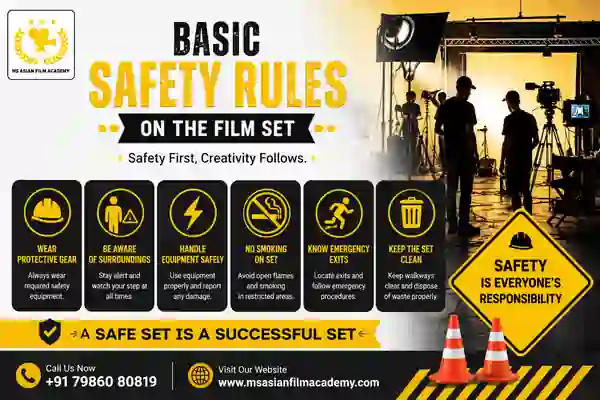
Basic Safety Rules on a Film Set: A Complete Guide for Aspiring Actors and Crew
Basic Safety Rules on a Film Set -Every year, thousands of young people dream of stepping onto a film set for the first time. The lights, the camera blocking, the energy of a live shoot — it all looks glamorous from the outside. But behind every successful film, web series, or theatre production is a strict, disciplined safety culture that protects everyone from the lead actor to the last light boy on set.
If you’re serious about building a career in front of or behind the camera, understanding basic safety rules on a film set isn’t optional — it’s a professional requirement. Production houses, casting directors, and insurance companies all expect performers and crew to know how a set operates safely. This is exactly why structured training at a recognised drama school matters so much before you walk onto a real set.
In this guide, we’ll break down the essential safety rules followed on Indian and international film sets, why they matter, and how proper training at an acting course prepares you to handle real-world shoot conditions with confidence.
Why Film Set Safety Matters More Than Ever
A film set is a temporary workplace built from scratch — often overnight — with electrical rigging, camera cranes, moving vehicles, fire effects, weapons props, and dozens of people moving in tight spaces. Unlike a regular office, a set changes location, layout, and risk factors almost daily. This is why safety awareness has to be built into every department, not just handled by one safety officer.
For actors, understanding safety protocol isn’t just about protecting yourself. It also builds trust with directors and production houses. An actor who understands blocking, marks, cable placement, and stunt coordination is far easier to work with — and far more employable — than one who needs constant supervision. This is one of the biggest (and most overlooked) reasons why formal training at a theatre classes program or acting institute gives students a real edge over self-taught performers.
Basic Safety Rules Every Film Set Follows
1. Mandatory Safety Briefing Before the Shoot
Every professional shoot day begins with a safety briefing, sometimes called a “tailgate meeting.” The assistant director or production manager walks the cast and crew through:
- Emergency exits and assembly points
- Location-specific hazards (water bodies, heights, traffic, wildlife)
- Special effects planned for the day (fire, smoke, rain rigs)
- Contact details of the on-set medic or nearest hospital
Actors trained in a structured acting classes environment are taught to always attend this briefing fully, ask questions if unclear, and never assume “it’ll be fine.” This single habit prevents the majority of on-set accidents.
2. Clear Marking of Restricted and Hazard Zones
Cables, lighting rigs, camera dollies, and crane paths are usually marked with hazard tape or cones. Actors and junior crew must never cross these zones during a live take or rehearsal without clearance from the floor manager.
A common rookie mistake — one drama schools specifically train students to avoid — is wandering “in character” into a restricted zone because you’re focused on the emotional beat of the scene. Discipline and spatial awareness are core parts of any serious acting course curriculum for exactly this reason.
3. Fire Safety and Special Effects Protocol
Fire elements, smoke machines, and pyrotechnics are among the highest-risk components of any shoot. Basic rules include:
- No open flame scenes without a licensed fire safety officer present
- Fire extinguishers and sand buckets placed within visible reach
- A minimum safe distance maintained between actors and fire rigs unless specifically rehearsed and cleared
- No synthetic or loose-fitting costumes near open flame without fire-retardant treatment
Reputed production houses will not proceed with a fire sequence unless every actor involved has been individually briefed and given a rehearsed cue to move away safely.
4. Stunt and Action Sequence Safety
Stunt work is one of the most tightly regulated areas of Indian and international filmmaking. Rules typically include:
- Only certified stunt coordinators design and supervise action sequences
- Actors never attempt a stunt beyond their trained capability, even under pressure to “just try it once”
- Safety mats, harnesses, and rigging are checked before every single take — not just the first one
- A dedicated medic remains on standby during all action or stunt blocks
This is precisely why serious performers pursue structured film making course programs that include practical exposure to how action blocks are actually rehearsed, rather than learning purely from watching films.
5. Electrical and Rigging Safety
Film sets run on heavy-duty lighting, generators, and extensive cabling — often set up in outdoor or semi-permanent locations. Basic protocol includes:
- All cables taped down or covered with cable ramps in walking areas
- No exposed wiring near water sources or during rain shoots
- Rigging and overhead lighting checked and signed off by a qualified gaffer before every shoot day
- Emergency power cut-off procedures clearly communicated to the full unit
6. Weapon and Prop Safety
Whether it’s a prop knife, a licensed firearm replica, or a sword for a period drama, weapon safety rules are strict and non-negotiable:
- All weapon props are checked in and checked out by the props master
- No actor handles a weapon prop unsupervised, even during rehearsal
- Live-action weapon sequences are rehearsed in slow motion multiple times before a full-speed take
- Any prop resembling a real firearm must be clearly marked and handled per local regulations
7. Height, Water, and Outdoor Location Safety
Scenes involving rooftops, cliffs, water bodies, or moving vehicles require additional precautions:
- Safety harnesses and secure anchor points for any height work
- Trained lifeguards or divers present for water sequences
- Actors briefed on cold water shock, currents, and exit points before filming near natural water bodies
- Vehicle stunts choreographed at reduced, controlled speeds with spotters present
8. Personal Health and Hygiene on Set
Safety isn’t only about accidents — it also covers wellbeing:
- Adequate hydration and shaded rest areas, especially for outdoor summer shoots
- First-aid kits and a trained on-set medic present at all times
- Reasonable working hour limits, particularly for child actors
- COVID-era protocols (sanitisation, testing) still followed on many professional productions
9. Communication Protocol During a Take
A film set runs on very specific verbal commands: “Rolling,” “Speed,” “Action,” and “Cut.” Every person on set — actor or crew — is trained to freeze and stay silent the moment “rolling” is called, and to only move once “cut” is confirmed. This single discipline prevents accidental injuries caused by people moving unexpectedly during a live take, especially around cameras, dollies, or crane arms.
10. Respecting the Chain of Command
Every department on a film set — direction, camera, lighting, sound, art, stunts — has a clear hierarchy. In an emergency, instructions from the assistant director or safety officer must be followed immediately, without argument or hesitation. This isn’t about ego; it’s about making sure decisions are made fast and consistently when seconds matter.
Common Mistakes New Actors Make Around Set Safety
Even talented performers can unintentionally put themselves or others at risk when they haven’t been trained on set etiquette. Some of the most common mistakes include:
- Wandering off marked positions to “get into character,” without realising they’ve stepped into a hazard zone or a camera’s blind spot.
- Touching props or weapons without checking with the props department first, assuming a prop is safe simply because it “looks fake.”
- Ignoring the assistant director’s instructions during a fast-paced schedule because they’re focused on their own performance rather than the safety of the overall unit.
- Ignoring fatigue and dehydration, especially during long outdoor shoots, because they don’t want to appear unprofessional by asking for a break.
- Attempting an unrehearsed stunt because a director casually suggests trying something “just once” for a better shot, without stunt coordinator clearance.
- Talking or moving during a live take, breaking concentration for the whole unit and sometimes causing a safety issue if crew members are mid-movement with equipment.
None of these mistakes come from a lack of talent. They come from a lack of exposure to how a real set actually functions. This is exactly the gap that structured acting classes and theatre classes are designed to close — by simulating real production conditions long before a student ever steps onto a paid shoot.
The Role of Discipline in a Long-Term Acting Career
Safety awareness and professional discipline aren’t just checkboxes for your first job — they shape your entire career trajectory. Directors and producers talk. A reputation for being safety-conscious, punctual, and easy to direct travels fast in the industry, often faster than a single great performance.
Actors who come from a proper drama school background typically carry these habits instinctively:
- Arriving on set well before their call time, in costume and ready
- Knowing their lines and blocking cold, so mental energy goes toward safety awareness, not scrambling to remember dialogue
- Communicating clearly with the director and DOP if something feels physically unsafe, instead of staying silent out of fear of seeming difficult
- Respecting junior crew members’ warnings about hazards, rather than dismissing them because of seniority or ego
This is the invisible, unglamorous side of acting that rarely gets discussed in interviews — but it’s often the exact quality that keeps an actor employed for decades instead of a single season.
How Formal Training Builds Set-Ready Professionals
Reading a list of rules is one thing. Internalising them under real shoot pressure — hot lights, tight schedules, a director calling for “one more take” — is another. This is exactly the gap that structured training closes.
At institutes offering serious theatre classes and screen-acting programs, students don’t just learn dialogue delivery and emotional range. They’re trained on:
- How to hit your mark without looking down
- How to work safely around a moving camera or crane
- How to take direction quickly during high-pressure retakes
- How to conduct yourself professionally around senior actors and crew
This kind of on-set discipline is a major reason casting directors and production houses prefer actors who’ve trained at a recognised drama school over those who’ve only performed on social media or in college fests.
Choosing the Right Acting School: What Actually Matters
If you’re searching for acting classes near me in Chandigarh, or comparing options for the best acting school in India, safety and professionalism should be part of your evaluation checklist — not just glamour shots on a website. Ask any institute you’re considering:
- Do they offer supervised, real-set style practical training?
- Do trainers have genuine film or television industry experience?
- Is there a structured acting course curriculum, or is it unstructured workshops?
- Do they offer specialisation beyond acting — such as a film direction course or modelling course — for students who want to explore multiple creative paths?
- What is their actual placement record, not just a marketing claim?
This is where MS Asian Film Academy stands apart among institutes claiming to be the top acting school in India. With industry-experienced faculty, real production-style training, and a genuine 100% placement support system, students don’t just learn acting theory — they graduate set-ready, safety-conscious, and industry-prepared.
Why MS Asian Film Academy is Building India’s Next Generation of Screen-Ready Talent
MS Asian Film Academy offers a complete ecosystem for creative careers, not just acting classes in isolation. Students can explore:
- A comprehensive acting course covering screen and stage performance
- A dedicated film direction course for those who want to move behind the camera
- A practical film making course covering production, cinematography, and editing fundamentals
- A professional modelling course for students pursuing fashion and commercial work
- The full range of programs listed on the courses page
Every program is designed with practical, on-set style training so students walk into their first real shoot already understanding set etiquette, safety protocol, and professional discipline — the same standards outlined throughout this article.
Frequently Asked Questions (FAQ)
Q1. What are the basic safety rules on a film set? The core rules include mandatory safety briefings, marked hazard zones, fire and stunt safety protocols, electrical and rigging checks, weapon prop handling procedures, and strict communication discipline during live takes.
Q2. Who is responsible for safety on a film set? While the assistant director and safety officer coordinate overall safety, every individual on set — from lead actors to junior crew — is responsible for following instructions and reporting hazards immediately.
Q3. Do acting schools teach on-set safety? Yes. Reputed acting institutes and drama schools include practical, set-style training so students understand real production discipline, not just performance technique.
Q4. Is MS Asian Film Academy a good option for acting classes near me in Chandigarh? Yes. MS Asian Film Academy offers structured acting, direction, filmmaking, and modelling courses with industry-experienced trainers and 100% placement support, making it a strong choice for students in and around Chandigarh.
Q5. Does MS Asian Film Academy offer 100% placement? Yes, MS Asian Film Academy is known for its 100% placement support system, helping students transition from training directly into real industry opportunities.
Q6. What courses does MS Asian Film Academy offer besides acting? Alongside its acting course, the academy offers a film direction course, film making course, and modelling course, giving students multiple paths into the entertainment industry.
Q7. How long does it usually take to become set-ready as an actor? This varies by individual, but most structured acting programs are designed to take a student from beginner to set-ready confidence within a few months to a year, depending on the depth of the course, prior experience, and how consistently the student practices outside class hours.
Q8. Can students pursue both acting and filmmaking training together? Yes. Many students at MS Asian Film Academy choose to combine their acting course with a film making course or film direction course, giving them a well-rounded understanding of both sides of the camera — something that makes them far more versatile and employable across the industry.
A Final Word on Safety and Craft
Great acting isn’t just about raw talent or emotional depth — it’s about being a dependable, safety-conscious professional that a production team can trust under pressure. Every basic safety rule outlined in this guide exists because, at some point in film history, a real incident taught the industry a hard lesson. Following these rules isn’t a formality; it’s a form of respect — for your own wellbeing, for your fellow cast and crew, and for the craft itself.
Whether you’re preparing for your first short film, auditioning for a television project, or dreaming of a lead role in a feature film, the foundation is always the same: discipline, preparation, and genuine industry-standard training. That foundation is exactly what a serious acting course, drama school, or theatre classes program should give you before you ever step onto a live set.
Ready to Start Your Journey the Right Way?
Understanding film set safety is the first real sign that you’re ready to be taken seriously as an actor or filmmaker. The best way to build this discipline — along with genuine performance skill — is through structured, practical training at an institute that treats you like an industry professional from day one.
If you’re looking for acting classes near me in Chandigarh, or comparing the best acting school in India and the top acting school in India, it’s time to see what MS Asian Film Academy can offer you.
📞 Call now: +91 7986080819 🌐 Visit: www.msasianfilmacademy.com 🎬 Explore all programs: msasianfilmacademy.com/courses
Your seat in India’s most industry-connected acting, direction, filmmaking, and modelling programs — with 100% placement support — is one call away. Don’t just dream about the film set. Get trained to walk onto it, ready.
Basic Safety Rules on a Film Set –Supported by Nav Times News, Powered by MSasian Entertainment , Supported by MSAFA