
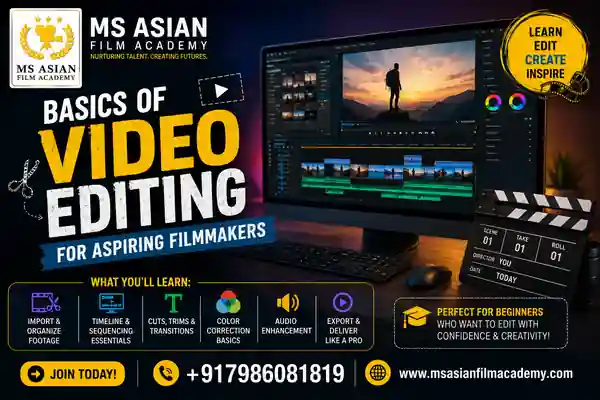
Basics of Video Editing for Aspiring Filmmakers
Basics of Video Editing for Aspiring Filmmakers – Every great film is made twice — once on set, and once again in the edit bay. If you have ever watched a scene and felt your pulse quicken at exactly the right second, that was not an accident. It was a decision, made by an editor who understood rhythm, story, and the emotional weight of a single cut. For anyone dreaming of a career behind the camera, learning the basics of video editing is not optional homework — it is the backbone of visual storytelling.
At MS Asian Film Academy (MSAFA) in Chandigarh, we tell every new batch of students the same thing on day one: shooting is only half the film. The other half happens later, in a quiet room, frame by frame. This guide breaks down what editing actually involves, the skills you need to build, and why understanding the edit makes you a stronger filmmaker, director, or even actor — whatever path you eventually choose.
What Is Video Editing, Really?
At its simplest, video editing is the process of selecting, arranging, and refining raw footage into a finished, coherent piece of visual storytelling. But that definition undersells how much creative control lives inside an edit suite. An editor decides pacing, tone, emotional beats, and even the meaning of a scene, simply by choosing which take to use and where to place the cut.
Think of raw footage as ingredients and the edit as the recipe. Two editors given the exact same shots can produce two completely different films — one tense and claustrophobic, another light and comedic — purely through editing choices. This is why editing is often called the “invisible art.” Done well, an audience never notices it. Done poorly, it’s the only thing they notice.
Why Every Aspiring Filmmaker Should Learn Editing First
There is a reason most serious film schools, including practical, industry-facing institutes like MSAFA, insist that directors, cinematographers, and even actors get hands-on exposure to editing early in their training.
It teaches you to shoot with purpose. Once you have sat through hours of unusable footage because a shot didn’t have a clean entry or exit point, you never make that mistake on set again. Editing knowledge makes you a more efficient, more disciplined filmmaker from the moment you pick up a camera.
It sharpens your storytelling instincts. Editing is where structure lives. You start to understand why a scene needs to breathe, why a reaction shot matters more than dialogue, and why silence can be louder than a musical score.
It builds respect for collaboration. A filmmaker who understands editing communicates better with their editor, gives cleaner direction to actors, and plans coverage that actually serves the story instead of creating problems in post.
If you are serious about a future in cinema, editing fundamentals belong right alongside cinematography, sound design, and — just as importantly — performance training, since knowing how a performance will actually be cut together changes how you direct actors on set.
The Core Stages of Video Editing 9Basics of Video Editing for Aspiring Filmmakers)
Professional editing is not one single task; it unfolds across distinct stages, each demanding a different mindset.
1. Logging and Organising Footage
Before a single cut is made, footage needs to be reviewed, labelled, and organised. Editors typically log each take, note the best performances, and flag technical issues like focus problems or audio glitches. This unglamorous groundwork is what separates a smooth edit from a chaotic one. Skipping it is the single biggest mistake beginners make — and it costs hours later.
2. The Rough Cut (Assembly Edit)
This is the first pass, where the editor assembles the film’s basic skeleton using the strongest available takes, in roughly the right order. The rough cut is intentionally imperfect. Its job is to confirm that the story works structurally before time is invested in polish.
3. The Fine Cut
Here, pacing gets refined. Scenes are trimmed, transitions tightened, and performances re-evaluated. This is where an editor starts asking harder questions: Does this scene run too long? Does cutting to a close-up here heighten the tension or kill it? A strong fine cut is where a film’s rhythm truly comes alive.
4. Sound Design and Music
Picture-lock rarely means the work is finished. Dialogue needs cleaning, ambient sound needs layering, and a score or soundtrack needs to be timed against emotional beats. Many beginner editors underestimate sound entirely — yet audiences forgive imperfect visuals far more easily than they forgive bad audio.
5. Colour Correction and Grading
Colour correction fixes technical inconsistencies between shots (matching exposure and white balance), while colour grading applies a deliberate visual mood — the cool blues of a thriller or the warm ambers of a nostalgic drama. This stage is where a film gets its distinct visual identity.
6. Final Export and Delivery
The last stage involves exporting the finished film in the correct format, resolution, and codec for its intended platform, whether that’s a festival submission, a streaming platform, or social media.
Essential Video Editing Techniques Every Beginner Should Know
Continuity Editing
This ensures that action flows logically across cuts — a character picking up a cup in one shot should be holding it, not setting it down, in the next. Continuity is invisible when done right and painfully obvious when it isn’t.
The Cutaway
A cutaway shot briefly diverts attention to something else in the scene — a reaction, an object, a background detail — often used to hide a jump cut or add visual variety without breaking narrative flow.
The J-Cut and L-Cut
These are two of the most powerful tools in an editor’s kit. A J-cut lets audio from the next scene begin before its visuals appear, easing the transition. An L-cut does the reverse, letting audio from the current scene linger over the next set of visuals. Both create smoother, more natural-feeling transitions than a hard cut.
Match Cuts
A match cut connects two shots through similar visual composition, movement, or action, creating a sense of continuity or symbolic connection between otherwise unrelated scenes.
Montage
A montage compresses time, showing progress, change, or the passage of days or years through a rapid sequence of shots, often set to music. It is one of editing’s most economical storytelling devices.
Building an Editing Workflow That Actually Works
Beginners often dive straight into cutting without setting up a workflow, and it costs them hours of avoidable frustration later. A dependable editing workflow usually follows a similar shape, regardless of the project size.
Start with a project structure. Before importing a single clip, create organised folders for footage, audio, graphics, and exports. It sounds trivial until you’re three hours into a deadline searching for a misplaced file.
Sync footage and audio early. If you shot with a separate audio recorder — common in independent and student productions — sync your clips before you begin the rough cut. Trying to sync mid-edit breaks your creative flow and wastes time.
Edit in passes, not all at once. Trying to nail structure, pacing, sound, and colour simultaneously is how beginners burn out. Professional editors work in deliberate passes: structure first, refinement second, sound and colour last. Each pass has one job.
Save versions as you go. Label your project files by date or version number. Nothing is more painful than realising you preferred yesterday’s cut but overwrote it without a backup.
Take breaks and rewatch with fresh eyes. An editor who has stared at the same scene for six hours loses objectivity. Stepping away and returning later reveals pacing problems that were invisible in the moment.
This kind of disciplined workflow is exactly what we drill into students during hands-on post-production labs — because in a real production environment, sloppy organisation on set or in the edit bay directly costs a project time and money.
The Difference Between Editing for Film, Web, and Social Media
Not all editing serves the same goal, and understanding the platform you’re cutting for changes your approach entirely.
Film and long-form content rewards patience. Scenes can breathe, silences can linger, and pacing follows the emotional logic of the story rather than a countdown clock. Editors working in this space think in terms of acts, arcs, and slow-building tension.
Web and OTT content tends to demand tighter pacing and stronger hooks in the first few seconds, since viewers can abandon a video with a single tap. Editors here often trim more aggressively while still respecting story logic.
Social media content operates on an entirely different rhythm — often under 60 seconds, with faster cuts, bold captions, and a hook within the first two to three seconds. Vertical framing, trending audio, and rapid visual rhythm matter as much as narrative here.
Understanding these differences early prevents a common beginner mistake: applying cinematic pacing to a reel, or chopping a short film like a social media clip. The story format should always dictate the edit, not the other way around. (Basics of Video Editing for Aspiring Filmmakers)
Building Muscle Memory Through Practice Projects
Reading about editing theory only takes you so far. The fastest way to genuinely internalise pacing, rhythm, and structure is through repeated hands-on practice. A few practical exercises worth trying:
- Re-cut an existing scene. Take a short scene from a film you admire, find the raw dailies or shoot a rough recreation, and try re-editing it differently. This teaches you how much control an editor actually has over tone and meaning.
- Edit the same footage two ways. Cut one version as a drama and another as a comedy using identical clips. It’s a fast, humbling way to understand how pacing and juxtaposition shape audience perception.
- Build a 60-second montage from unrelated footage you already have on your phone. This sharpens your instinct for rhythm and music syncing under real time constraints.
- Study scene transitions from professional films frame by frame, noting exactly where each cut lands relative to dialogue, movement, and music beats.
These are the same kinds of practical exercises we run students through in our post-production sessions at MSAFA, because editing, like acting, is a craft you build through repetition — not something you absorb by reading a single article, including this one.
Choosing Your First Editing Software
Beginners often get stuck comparing software instead of practising. A few realistic starting points:
- DaVinci Resolve – Industry-grade colour tools with a genuinely capable free version; steep learning curve but worth it long-term.
- Adobe Premiere Pro – The industry standard across Indian production houses and OTT platforms; strong integration with other Adobe tools.
- Final Cut Pro – Mac-only, fast, and popular among independent filmmakers for its speed and intuitive timeline.
- CapCut – A genuinely useful entry point for short-form and mobile content before moving to professional tools.
The software matters far less than understanding editing principles. A filmmaker who understands pacing, rhythm, and story can pick up any software in a matter of weeks. A person who only knows keyboard shortcuts, but not why a cut works, will always hit a creative ceiling.
Common Mistakes Beginner Editors Make
Cutting too fast, too often. New editors often mistake rapid cutting for energy. In reality, unmotivated fast cuts confuse the audience and drain emotional weight from a scene.
Ignoring pacing rhythm. Every genre has its own natural tempo. A horror film breathes differently than a comedy. Editing on instinct without watching reference films from your genre is a common beginner trap.
Underusing silence. Music and sound effects are often layered on top of every single moment out of nervousness. Sometimes the most powerful edit is the one with nothing playing at all.
Neglecting audio quality. Viewers tolerate rough visuals surprisingly well but abandon videos within seconds of poor or inconsistent audio.
Editing without a clear intention. Every cut should answer a question: what is this doing for the story? If there’s no answer, it likely doesn’t belong.
How Editing Connects Directors, Actors, and the Final Story
Here’s something aspiring filmmakers rarely hear until they’re already on a set: an editor can only work with what a director captures, and a director can only capture what an actor gives them. The entire chain — performance, direction, and edit — has to work together, or the final film falls apart regardless of how skilled the editor is.
This is precisely why filmmaking education works best when it isn’t siloed. At MSAFA, our film direction course and filmmaking course are structured so that students understand editing, camera, and storytelling as one connected craft — not separate subjects taught in isolation. A director who understands the edit gives cleaner coverage. An editor who understands performance protects the actor’s best moments instead of cutting away from them.
And that brings us to a part of filmmaking that often gets overlooked in purely technical conversations: performance itself.
Why Acting Training Matters for Filmmakers Too
You don’t need to become an actor to benefit from acting training — but understanding how performance works fundamentally changes how you direct, shoot, and edit a scene. Filmmakers who have spent time in front of the camera understand nuance: the difference between a genuine pause and a hesitant one, the value of letting an actor’s eyes do the talking instead of cutting away too soon.
This is why MSAFA’s acting course sits at the very core of our curriculum, alongside our dedicated drama school and theatre classes, which build the discipline, voice control, and emotional range every serious performer — and every serious director — eventually needs. Many of our filmmaking students, even those who never intend to act professionally, take our acting classes specifically to understand performance from the inside out.
If you are based in Punjab or nearby states and searching for acting classes near me in Chandigarh, MSAFA’s campus offers structured, industry-mentored training designed for people serious about screen and stage careers — not casual weekend workshops.
Building a Career Beyond the Editing Timeline
Understanding video editing basics gives you a technical foundation, but a genuine filmmaking career is built on the full ecosystem: writing, direction, cinematography, performance, and post-production working in sync. This is why aspiring filmmakers benefit enormously from training environments that combine all these disciplines under one roof, with real industry mentorship and hands-on production experience rather than theory alone.
MS Asian Film Academy has built its reputation as one of the top acting schools in India precisely because we don’t separate craft from career. Every course — whether it’s acting, film direction, filmmaking, or modelling — is built with the same principle: train students the way the industry actually works. Our students get exposure to real productions, guided by mentors connected to MS Groupe, our affiliated production house, which gives graduates a genuine bridge from classroom training to on-set experience.
This industry-linked structure is also why MSAFA is widely regarded among students and parents as the best acting school in India offering 100% placement support — because training here doesn’t end at the classroom door. It continues onto real sets, real productions, and real career opportunities.
Your Next Step (Basics of Video Editing for Aspiring Filmmakers)
Editing is a craft you can start learning today, with nothing more than free software and raw footage from your phone. But turning that curiosity into a genuine filmmaking or acting career requires structured mentorship, real production exposure, and a curriculum that connects every discipline — from the camera to the cutting room to the stage.
If you’re ready to move from watching films to making them, explore MSAFA’s full range of programmes on our courses page, or reach out directly to speak with our admissions team about our acting classes, drama school programme, film direction course, and filmmaking course.
Call or WhatsApp us at +91 7986080819 to book a campus visit, ask about upcoming batches, or learn more about our 100% placement support. Whether you’re searching for the best acting school in India, a serious drama school, or hands-on filmmaking training in Chandigarh, MSAFA is built to take you from your first short film to your first real credit.
MS Asian Film Academy (MSAFA), Chandigarh, is a film and performing arts institute offering acting classes, theatre and drama training, film direction, filmmaking, and modelling courses, backed by industry mentorship through MS Groupe. Visit www.msasianfilmacademy.com or call +91 7986080819 to learn more.
Basics of Video Editing for Aspiring Filmmakers –Supported by Nav Times News, Powered by MSasian Entertainment , Supported by MSAFA