
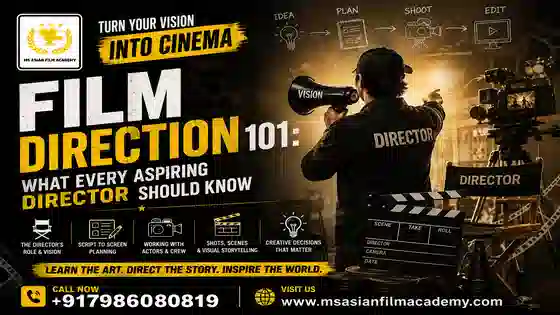
Film Direction 101: What Every Aspiring Director Should Know | MSAFA |
Every great film you’ve ever loved — the ones that made you cry, laugh, or sit in stunned silence during the credits — had one person quietly holding the whole vision together: the director. Film direction is one of the most creatively demanding and personally rewarding careers in the entertainment industry, but it’s also one of the most misunderstood. Many aspiring filmmakers assume direction is only about “calling the shots” on set. In reality, it’s a discipline that blends storytelling, psychology, technical craft, and leadership.
If you’re an aspiring director in India wondering where to start, this guide breaks down everything you need to know — the core skills, the process, the common mistakes, and how proper training through a structured film direction course can fast-track your journey into the industry.
What Is Film Direction? Understanding the Director’s Role
At its core, film direction is the art of translating a written screenplay into a living, breathing visual experience. The director is responsible for the creative vision of a film — how it looks, how it feels, how the story unfolds emotionally, and how every department (camera, sound, art, editing, and performance) works together to serve that vision.
A director wears many hats across the filmmaking process:
- Story interpreter — reading between the lines of a script to find its emotional core
- Visual architect — deciding how each scene should look, move, and feel
- Actor’s guide — helping performers find truth in their characters
- Team leader — coordinating dozens (sometimes hundreds) of crew members
- Problem solver — making quick decisions when things go wrong on set (and they always do)
Unlike what social media might suggest, direction isn’t about shouting “action” and “cut” while sitting in a fancy chair. It’s disciplined, detail-oriented work that starts months before the camera ever rolls and continues well into the editing room.
Core Skills Every Aspiring Director Needs
Before you can direct a feature film, you need to build a strong foundation across several interconnected skills. Most successful directors didn’t start with fame — they started with fundamentals, often learned through structured training at institutes offering a proper film direction course.
1. Storytelling and Script Analysis
Every frame you shoot should serve the story. Directors need to understand structure — setup, conflict, climax, resolution — and be able to identify a script’s emotional throughline. This is why many top directors also study acting or writing early in their careers.
2. Visual Language and Composition
How you frame a shot changes how an audience feels about it. A close-up creates intimacy. A wide shot creates isolation or scale. Directors must understand composition, camera movement, lighting, and color to communicate meaning without saying a word.
3. Working With Actors
This is where many new directors struggle the most. You can have a brilliant shot list, but if the performances feel flat, the film won’t connect. Directors need to know how to communicate with actors, give useful notes, and create an environment where genuine emotion can happen on cue.
4. Leadership and Communication
On a film set, you’re managing everyone from the cinematographer to the spot boy. Clear, calm, confident communication is non-negotiable. Indecisive directors lose the crew’s trust fast — and a set without trust falls apart.
5. Technical Fluency
You don’t need to operate the camera yourself, but you need to speak the language of your cinematographer, editor, and sound designer fluently enough to get exactly what you envision.
Understanding Screenplay and Story Structure
Before pre-production even begins, a director’s real work starts with the script. Reading a screenplay as a director means asking different questions than a casual reader would:
- What does this character want, and what’s stopping them from getting it?
- Where is the emotional turning point of this scene?
- What’s the visual metaphor hiding inside this moment?
- How does this scene connect to the film’s larger theme?
Directors often break a script down into a shot list and a storyboard, mapping out exactly how each scene will be captured before a single day of shooting happens. This pre-visualization process saves enormous time and money on set, and it’s one of the first practical skills taught in any serious film direction course.
Working With Actors: Directing Performances That Feel Real
This is arguably the most underrated skill in filmmaking. A technically perfect shot means nothing if the performance inside it feels false. Great directors know how to:
- Give actionable notes instead of vague feedback (saying “be sadder” doesn’t help; giving the actor a specific memory or objective does)
- Create a safe, trusting environment so actors can take emotional risks
- Recognize the difference between a technically correct take and an emotionally true one
- Adjust their communication style for different actors — some need technical direction, others need emotional guidance
This is exactly why many aspiring directors benefit from taking acting classes themselves, even if they never plan to perform on camera. Understanding an actor’s process from the inside — how they build a character, how they access emotion, how rehearsal works — makes you a dramatically better director. Institutes that offer both acting classes and film direction courses under one roof, like MS Asian Film Academy, give students this crucial dual perspective that self-taught filmmakers often miss for years.
If you’ve ever wondered why some of the world’s most respected directors have backgrounds in theatre classes or a drama school, this is why. Stage training builds an instinct for pacing, blocking, and human behavior that translates directly to the screen.
Camera, Shot Composition, and Visual Storytelling
Once you understand the story and the performances you need, the next layer is visual execution. This includes:
Shot sizes — wide, medium, close-up, extreme close-up — each shot size carries emotional weight and narrative purpose.
Camera movement — a static shot feels observational; a handheld shot feels urgent or chaotic; a slow push-in builds tension or intimacy.
Lighting and mood — high-key lighting feels optimistic and open; low-key, shadow-heavy lighting feels tense or mysterious.
Color palette — color grading and production design choices reinforce the emotional tone of a scene long before the audience consciously notices.
New directors often try to make every shot “impressive” instead of purposeful. The best directors ask a simpler question before every shot: what does this composition make the audience feel, and does it serve the story?
Editing and Post-Production Basics for Directors
A director’s job isn’t finished when shooting wraps. In fact, the film is truly “written” a third time in the edit. Understanding basic editing principles helps directors:
- Shoot with coverage in mind, so editors have flexibility later
- Understand pacing and rhythm across a scene and the full film
- Collaborate effectively with editors, colorists, and sound designers
- Make smarter decisions on set about what footage will actually be needed
Directors who understand post-production rarely waste shooting days on footage that will never make the final cut — a lesson that saves both time and budget on any production, big or small.
Common Mistakes Aspiring Directors Make
Even talented beginners tend to repeat the same avoidable mistakes:
- Over-directing actors — giving too many notes at once instead of one clear, actionable adjustment
- Ignoring pre-production — jumping straight to shooting without a locked shot list or rehearsal
- Prioritizing style over story — chasing “cool shots” that don’t serve the narrative
- Poor communication with the crew — assuming everyone can read your mind instead of clearly articulating your vision
- Skipping formal training — trying to learn everything through trial and error instead of structured mentorship, which costs far more time (and often money) in the long run
Formal training through a recognized institute helps you skip years of guesswork by learning directly from working industry professionals.
The Traditional Path: Starting as an Assistant Director
Most working directors in the Indian film industry didn’t walk straight onto a set and start calling shots. They started as assistant directors (ADs), learning the craft from the ground up. This path remains one of the most reliable ways to break into direction, and understanding it helps aspiring filmmakers set realistic expectations.
Third AD typically handles logistics — managing extras, coordinating schedules, and keeping the set organized.
Second AD manages the daily call sheet, communicates with actors about timing, and keeps production on schedule.
First AD works closest to the director, managing the shot list, pacing the shooting day, and translating the director’s vision into an executable plan for the crew.
Spending even one or two projects as an AD teaches you things no classroom can fully replicate — how a real set actually runs under time pressure, how department heads communicate, and how a director’s decisions ripple through every part of production. Many institutes now build AD-style practical modules directly into their film direction course curriculum so students get this exposure before ever stepping onto a professional set.
Directing for Different Formats: Film, OTT, and Branded Content
Traditional cinema is no longer the only career path for a trained director. India’s entertainment landscape has expanded dramatically, and directors today work across several formats:
- Feature films — the traditional path, requiring the strongest command of long-form narrative structure
- OTT web series — episodic storytelling with different pacing demands than a two-hour film, currently one of the fastest-growing employment areas for new directors
- Branded and corporate content — brands increasingly hire trained directors for high-quality video campaigns, offering steady, well-paying work outside the traditional film industry
- Music videos and short-form content — a strong training ground for visual style and rapid-fire storytelling
Understanding this broader landscape matters because it changes how you build your early portfolio. A student focused only on feature-length ambitions may overlook the steady, skill-building opportunities available in branded content and digital series — both of which are actively hiring trained directors right now.
Building Your Directing Portfolio
Once you have foundational skills, the next step is building a body of work that demonstrates your voice as a filmmaker. This typically includes:
- Short films — the most common and accessible way to showcase directing ability
- Student and collaborative projects — working with actors and crew from a drama school or acting program gives you access to trained talent for your projects
- Film festival submissions — a strong short film can open doors at festivals, which is where many directors get discovered
- A demo reel — a curated 2–3 minute edit of your best directorial work
Aspiring directors trained at institutes that also run acting classes near me in Chandigarh and beyond often have a built-in advantage here — access to trained actors, working crew, and functional studio space to actually shoot their projects, instead of trying to coordinate everything independently.
How to Start Your Journey Into Film Direction in India
India’s film and OTT industry is growing rapidly, creating consistent demand for trained directors, assistant directors, and content creators across films, web series, and branded content. If you’re serious about a directing career, here’s a practical starting path:
- Get structured training — Enroll in a proper film direction course that covers screenplay analysis, camera, editing, and working with actors — not just theory.
- Cross-train in acting — Even a short set of acting classes dramatically improves your ability to direct performances.
- Build your network — Attend workshops, connect with actors, cinematographers, and editors early.
- Make short films constantly — Every project, even small ones, sharpens your instincts.
- Study working professionals — Analyze how established directors block scenes, work with actors, and structure their films.
This is exactly the path designed into the curriculum at MS Asian Film Academy, recognized as one of the best acting schools in India and a top acting school in India for students who want both performance training and direction-focused filmmaking skills in one place.
Why Choose MS Asian Film Academy for Film Direction Training
MS Asian Film Academy (MSAFA), based in Chandigarh/Zirakpur, is built for students who want industry-relevant, hands-on training — not just classroom theory. Here’s what sets the academy apart:
- Comprehensive film direction course covering screenplay breakdown, shot composition, working with actors, and post-production fundamentals
- Industry-experienced faculty who bring real set experience into the classroom
- Access to acting talent through the academy’s own acting course, giving direction students real actors to work with on practical exercises
- Hands-on filmmaking practice through the film making course, covering camera, lighting, and on-set workflow
- Modelling and on-screen presence training via the modelling course for students who want to understand on-camera presence from both sides of the lens
- 100% placement assistance, connecting graduates with real industry opportunities through the academy’s network and its affiliated production house, MS Groupe
- Recognized as a drama school and theatre classes hub for students who want a strong foundation in live performance before moving to screen direction
Whether you’re searching for acting classes near me in Chandigarh or looking for the best acting school in India to build a serious directing career, MSAFA offers the complete ecosystem — training, practice, industry exposure, and placement support — under one roof. Explore the full range of programs on the courses page.
Frequently Asked Questions
Q1: Do I need to take acting classes before learning film direction?
It’s not mandatory, but highly recommended. Understanding an actor’s process — how they build a character and access emotion — makes you significantly better at directing performances. Many top film schools, including MSAFA, encourage direction students to take at least foundational acting classes.
Q2: What is the difference between a drama school and a film direction course?
A drama school or theatre classes program focuses on live stage performance, character work, and voice — foundational skills for any storyteller. A film direction course focuses specifically on translating story into visual, camera-based filmmaking, including shot composition, editing, and set leadership. MSAFA offers both, allowing students to build a complete filmmaking skill set.
Q3: Can I become a film director without a formal degree?
Yes — direction is a skill-based career, not a degree-dependent one. That said, structured training through a recognized film direction course dramatically shortens the learning curve compared to teaching yourself through trial and error.
Q4: How long does it take to become a working film director?
It varies widely, but most working directors spend 2-5 years building skills, short films, and industry connections after formal training before directing a feature-length project or a professional web series.
Q5: Does MS Asian Film Academy offer placement support for direction students?
Yes. MSAFA provides 100% placement assistance, connecting graduates with opportunities across films, OTT content, and branded content through its industry network and affiliated production house, MS Groupe.
Q6: Is Chandigarh a good place to study film direction and acting?
Yes. Chandigarh and the tricity region have a growing film and content production ecosystem. Searching for “acting classes near me in Chandigarh” increasingly leads students to institutes like MSAFA that combine acting, direction, and filmmaking training with real industry placement support.
Ready to Start Your Directing Journey?
Great directors aren’t born overnight — they’re trained, mentored, and given real opportunities to practice their craft. If you’re ready to turn your passion for storytelling into a real filmmaking career, MS Asian Film Academy is here to guide you every step of the way, from your first acting classes to your first short film as a director.
📞 Call us today at +91 7986080819 to book your consultation and take the first step toward becoming a professional filmmaker.
👉 Explore all programs: msasianfilmacademy.com/courses
Supported by Nav Times News, Powered by MSasian Entertainment , Supported by MSAFA .