
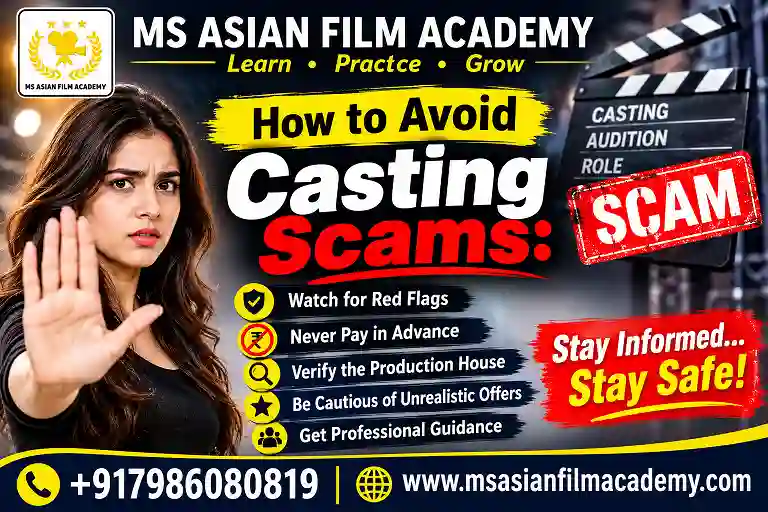
How to Avoid Casting Scams: A Complete Guide for Aspiring Actors in India
How to Avoid Casting Scams -Every year, thousands of hopeful actors and models leave home with one dream: to see their face on screen. Some of them also leave with a lighter wallet, a damaged reputation, and a dent in their confidence. They didn’t fail an audition. They fell for a fake one.
If you want to know how to avoid casting scams, you are already ahead of most newcomers. The entertainment industry is exciting, but it is also crowded with people who prey on that excitement. A single fake “casting director” with a WhatsApp number can drain your savings, waste months of your time, or put you in an unsafe situation.
This guide comes from what we see every day at MS Asian Film Academy in Chandigarh. Students walk in carrying stories of “registration fees”, “portfolio packages” and “guaranteed web series roles” that never existed. Below, we break down how these scams work, the red flags to watch for, how real casting happens, and what to do if you have already been targeted.
What Are Casting Scams?
Casting scams are fraudulent offers that pretend to be genuine acting, modelling or film opportunities. The goal is almost always the same: get money, personal data, or access to you.
A scammer might pose as a casting director, a production house, a talent agency or even a well-known OTT platform. They post an exciting call on Instagram, Facebook or a casting group, and wait for hopeful candidates to message them. Once you reply, the pressure begins.
The simplest way to remember the difference is this. In a real casting process, the production pays the actor. In a casting scam, the actor pays the “production”.
Why Casting Scams Are So Common in India
Understanding why scams thrive helps you spot them faster.
The industry is not centralised. There is no single license or government portal that every casting professional must display. That gap lets anyone claim to be a casting director.
Social media made reach cheap. A fake profile costs nothing. A scammer can borrow photos from a real production, copy a logo and look convincing within an hour.
Newcomers don’t know the process. If you have never been to a professional audition, you don’t know what is normal. A scammer uses that gap, and talks as though everything they ask for is standard practice. (How to Avoid Casting Scams)
Dreams make people hurry. Scammers know that a young actor afraid of missing “the one chance” will pay first and think later. That is why almost every scam comes with a deadline.
12 Red Flags That Signal a Casting Scam
You don’t need to be an industry insider to protect yourself. Watch for these warning signs.
- They ask for an upfront fee. Registration fees, audition fees, “file charges” or “slot booking” payments are the most common sign of fraud.
- They insist on a specific photographer. If the “casting director” says you must shoot your portfolio only with their recommended studio, you are being sold a package, not offered a role.
- The offer arrives with no audition. Real roles, even small ones, involve some form of audition, self-tape or look test. A role “confirmed” after a single photo should make you suspicious.
- Pressure and short deadlines. Lines such as “only two slots left” or “pay in the next hour” are classic pressure tactics.
- No verifiable company details. No website, no office address, no past projects, no credits you can check. Just a phone number.
- Communication only on WhatsApp or Telegram. Genuine casting teams use official email IDs and proper call sheets alongside messaging.
- Vague project details. If they can’t tell you the production house, director, shoot dates and character brief, there is probably no project.
- Guaranteed fame or income. No one can guarantee you a lead role, a viral career or a monthly income. Be careful with anyone who does.
- Poor language and unprofessional messages. One typo is human. A pattern of sloppy, copy-pasted messages is a warning.
- Requests for sensitive documents early. Aadhaar copies, bank details or passport scans before any contract is signed should never be shared.
- Private meetings in unusual places. Hotel rooms, private apartments or late-night “meetings” are never part of a professional casting process.
- Requests for inappropriate photos or videos. Any casting that asks for intimate content or “special favours” is predatory. Walk away and report it.
If even two of these show up together, stop and verify before you reply again.
Common Types of Casting Scams You Should Know
The Registration Fee Trap
You apply for a role in a film or web series and receive a quick reply: “You’re shortlisted! Pay ₹2,000 to confirm your audition.” Once you pay, you may be asked for more money for “ID cards”, “insurance” or “agreement charges”. Then the number goes silent.
The Portfolio Photoshoot Racket
Here the scammer says your portfolio is “not good enough” and sends you to a specific studio. The studio charges a heavy price, and the casting call quietly disappears. Genuine casting teams may ask for fresh photos, but they will never force you to use one particular photographer.
The Fake Agency Membership
Some people sell “membership” in an actor database and promise regular auditions. In reality, you pay yearly fees and get nothing. A legitimate talent agency earns a commission from the work it gets you, not from selling you access.
The Social Media and WhatsApp Casting Call
A post appears saying “Urgent: need 20 faces for a TV commercial.” The post is vague, there is no brand name, and everything runs through a DM. These posts often exist only to collect phone numbers and photos, or to funnel people into paid services.
The Out-of-City Shoot Offer
This one is more dangerous. You are told to travel to another city for a “shoot”, often with an unrealistic payment. Travel, stay and food are said to be “arranged” but the details are fuzzy. Never travel alone for an unverified project, and never send money for tickets to a stranger.
The Fake OTT or Big Banner Name
Scammers love to borrow the name of big platforms and famous production houses. They send convincing logos and even fake agreements. Always check the company’s official website and contact the production through the official channel before trusting any message. (How to Avoid Casting Scams)
How Genuine Casting Actually Works
Knowing what a real process looks like is your best shield. Here is how professional casting usually unfolds.
A casting brief is created. The production team shares a character breakdown covering age range, look, language, skills and shoot dates.
Casting directors reach out through professional channels. They contact agencies, acting schools, theatre groups and registered actors. Open calls exist, but they are announced with clear details.
You audition, self-tape or attend a look test. This is free. Whether it is a scene reading in an office or a self-tape you record at home, you are being assessed on talent, not on your ability to pay.
Shortlisting and callbacks follow. Producers and directors review the shortlisted actors, sometimes in more than one round.
A contract is signed before work begins. A real agreement mentions your role, payment, shoot dates, and working conditions. Read it carefully, and ask someone you trust to read it too.
Payment comes from the production. Whatever the budget, the money flows towards the actor. If it flows the other way, treat it as a red flag.
One honest note: low-budget independent films, student productions and some theatre projects may not pay much, or at all. That is not a scam, as long as it is clearly stated upfront and you are never asked to pay to participate.
A Step-by-Step Way to Verify Any Casting Call
Before you reply to an audition message, run through this quick checklist.
Step 1: Search the company name. Look for an official website, a professional social media presence and press mentions. A real production house leaves a trail.
Step 2: Check their past work. Can you find films, ads or shows they actually produced? Watch them. Match the credits to the names they mention.
Step 3: Look for the people, not just the brand. Search the casting director or producer by name. Are they connected to real projects? Do other actors speak of them?
Step 4: Ask for details in writing. Request the project name, the character brief, the audition location and the shoot dates by email. Genuine professionals will answer without fuss. Scammers dodge.
Step 5: Confirm through a second channel. If the message claims to be from a known production house, call or email them using contact details from their official website, not the ones in the message. (How to Avoid Casting Scams)
Step 6: Talk to your acting school or mentors. This is where being part of a proper institution helps. Trainers and alumni networks often know which calls are real. If you are a student at a reputable drama school, ask your faculty before you apply.
Step 7: Trust your instincts. If something feels off, it usually is. No role is worth ignoring your gut.
What to Do If You Have Already Been Scammed
It happens to smart people. If you’ve paid money or shared personal details, act quickly.
Stop all communication with the person, but keep every message, payment receipt, screenshot and number. This evidence is valuable.
Contact your bank or payment app immediately. Report the transaction and ask whether it can be flagged or reversed.
Report it on the National Cyber Crime Reporting Portal at cybercrime.gov.in, or call the national cyber crime helpline 1930, especially for online financial fraud. You can also file a complaint at your local police station.
Report the profile or group. Flag the fake account on Instagram, Facebook or whichever platform was used, so others are warned.
Warn your community. Tell your batchmates, your acting class and your friends in the industry. Scammers reuse the same tricks again and again, and a timely message can save someone’s savings.
Don’t feel ashamed. Being targeted does not make you foolish. Scammers are professionals at manipulation. Reporting is the strong thing to do.
Safety Tips for Young Actors and Aspiring Models
Safety matters just as much as money, and the risks are higher for young women, teenagers and people who have just moved to a new city.
- Meet only in professional spaces such as registered offices, studios or well-known public venues, and during normal working hours.
- Take a friend or family member along for auditions and meetings, especially in the early stages of your career.
- Share your live location with someone you trust.
- Keep sensitive documents like Aadhaar, PAN and bank details private until a verified contract is in place.
- If you are under 18, a parent or guardian must be involved in every step.
- Never agree to anything that makes you uncomfortable. A good opportunity will still be there after you say no to a bad one.
If you are interested in modelling, the same rules apply. You can learn how the profession works, and what a healthy start looks like, in our modelling course.
Why Proper Training Is Your Strongest Protection
Here is something that many beginners miss. Scammers target the unprepared. When you know how the industry works, what a real audition feels like, and how professionals behave, fake offers stand out immediately. (How to Avoid Casting Scams)
That’s the real value of joining proper acting classes or a reputed drama school. Training gives you more than technique. It gives you:
Industry awareness. You learn how casting, rehearsals, shoots and contracts actually work, so a fake process sounds wrong the moment you hear it.
A trusted network. Trainers, alumni and classmates share real opportunities and quickly flag suspicious ones.
Genuine portfolio-building. Instead of paying a random studio, you build showreels, scene work and stage experience through your training.
Confidence. A well-trained actor doesn’t panic when someone says “only one slot left.”
Stage discipline. Good theatre classes build voice, body language, improvisation and emotional range. They also teach you professional conduct, such as punctuality, preparation and respect for the crew.
If you are searching for acting classes near me in Chandigarh, make sure the school you pick is transparent about its curriculum, faculty and outcomes. Our acting course is designed around exactly this idea: practical training on stage and camera, combined with real industry exposure. You can see everything we offer on our courses page.
How to Choose an Acting School Without Falling for Another Scam
Sadly, some fake schools use the same tricks as fake casting agents. If you are comparing the best acting school in India or looking at lists of the top acting school in India, keep these points in mind.
Check the faculty. Are the trainers working professionals with real credits in theatre, film or television? Can you meet them?
Look at the curriculum. A good school shares a clear syllabus covering voice, movement, scene study, camera technique, improvisation and auditions.
Ask what is practical. Does the course include camera practice, stage performance and set exposure, or is it only theory?
Understand placement claims carefully. “100% placement” is a strong promise, and you should always ask what it means. Does it mean guaranteed auditions, agency tie-ups, work in real productions, or only a certificate? A trustworthy institute will explain how its placement support works and what you are expected to do. At MS Asian Film Academy, our placement-focused model is backed by the wider MS Asian Entertainment ecosystem, which includes a working production house that creates opportunities for trained students. Ask us any question about how this works before you enrol. (How to Avoid Casting Scams)
Talk to past students. Speak to alumni. Watch their work. Real success stories can be checked.
Visit in person. Sit in on a class, meet the staff and see the facilities. A school that hides nothing is one worth trusting.
Beware of pressure. If an admissions team uses “last seat” tactics or demands full payment on the first call, take a step back.
Many students also grow beyond acting. If you are curious about working behind the camera, explore our film direction course or our film making course. Understanding the full production process makes you a smarter actor and a harder person to fool.
Practical Habits That Keep You Safe Throughout Your Career
Avoiding scams isn’t a one-time act. It’s a habit. These simple practices will protect you for years.
Keep a professional presence. A clean Instagram profile, a simple portfolio and a basic showreel show that you are serious. They also make it easier for real casting directors to find you.
Use a dedicated email and phone number for work. This keeps your personal accounts safer.
Never pay to audition. If you remember only one rule from this article, make it this one.
Read every contract. Check the role, dates, payment terms, usage rights and cancellation clauses. If you don’t understand something, ask before you sign.
Keep records. Save the casting brief, emails and payment details of every project.
Stay in touch with your acting community. Alumni groups, theatre circles and workshops are rich sources of honest information.
Keep learning. Workshops, theatre productions and new training refresh your skills and widen your circle of trusted contacts.
Frequently Asked Questions About Casting Scams
How do I know if a casting call is real?
A real casting call comes from a verifiable production house or casting director, shares clear project details, never asks for money to audition, and offers a contract before work begins. Search the company, check its past work, and confirm details through an official channel.
Is it normal to pay a fee to audition?
No. Genuine auditions are free for actors. If someone asks for a registration or audition fee, treat it as a major red flag. Paid workshops and training are different, as they are services you knowingly choose, but they should never be disguised as casting. (How to Avoid Casting Scams)
Can a casting director ask me to use their photographer?
A reputable casting director may ask for updated photos, but they won’t force you to shoot with a specific studio or take a “package”. Being pushed toward one photographer is a common scam tactic.
Are casting calls on Instagram and WhatsApp safe?
Some are genuine, but many are not. Treat every social media casting call carefully, verify the person behind it, and never share money or sensitive documents. Use a second channel, such as the official website or email, to confirm.
Do acting classes help me avoid casting scams?
Yes. Good acting classes teach you how the industry works, introduce you to real professionals, and give you a network to check opportunities with. Informed actors are far harder to trick.
What should I do if someone asks for inappropriate photos or favours?
Stop all contact, keep the messages as evidence, and report the person to the police or the cyber crime portal at cybercrime.gov.in. No genuine casting requires anything of this kind.
How can I find reliable acting classes near me in Chandigarh?
Look for a drama school with experienced faculty, a clear syllabus, practical camera and stage training, transparent fees and verifiable alumni work. Visit in person and attend a demo class before you decide.
Does “100% placement” really mean guaranteed work?
It depends on how the institute defines it. Always ask what the placement covers, such as auditions, agency tie-ups or production work, and how the process works. A trustworthy school will explain this openly.
Final Thoughts: Dream Big, But Verify First (How to Avoid Casting Scams)
The entertainment world is full of wonderful opportunities, and it is also full of people who profit from your hope. The good news is that casting scams follow patterns. Once you know those patterns, you can spot them from a mile away.
Remember the basics: real productions pay actors, real auditions are free, real professionals share details in writing, and real opportunities never need panic. Build your skills, build your network, and build your confidence, because a prepared actor is a protected actor.
Ready to Build a Safe, Serious Acting Career?
At MS Asian Film Academy, we train aspiring actors through hands-on acting classes, stage and theatre classes, and camera training, with placement-focused guidance backed by our own production ecosystem. If you are looking for a trustworthy drama school in Chandigarh, we’d love to meet you.
Call or WhatsApp us on +91 7986080819 to book a demo class and talk to our counsellors.
Visit www.msasianfilmacademy.com to explore all our courses and take the first confident step towards your acting career.
How to Avoid Casting Scams –Supported by Nav Times News, Powered by MSasian Entertainment , Supported by MSAFA