
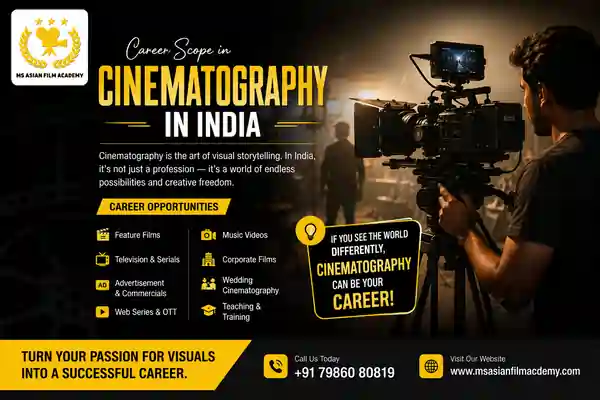
Career Scope in Cinematography in India: A Complete Guide for 2026
If you have ever watched a film and felt the story come alive through light, shadow, and camera movement, you have already experienced the magic of cinematography. Today, the career scope in cinematography in India is bigger than it has ever been. With OTT platforms, regional cinema, YouTube content, web series, and advertising all competing for visual storytellers, India needs trained cinematographers more than ever before.
In this guide, we will walk you through everything you need to know about building a career in cinematography in India — from what the job actually involves, to the skills you need, the institutes worth considering, expected salaries, and how allied training like acting classes, drama school, and theatre classes can make you a stronger filmmaker.
What Does a Cinematographer Do?
A cinematographer, also called a Director of Photography (DOP), is responsible for the visual look and feel of a film, show, or advertisement. They decide how a scene is lit, which lens tells the story best, how the camera should move, and how color and composition support the emotion of a moment.
Cinematography is not just about operating a camera. It is a blend of technical knowledge (lighting, lenses, camera settings, color grading) and artistic sensibility (composition, mood, storytelling through visuals). This combination is exactly why the career scope in cinematography in India continues to expand across films, television, digital content, and corporate media.
Why Cinematography Is a Promising Career in India
India produces more films every year than almost any other country in the world. Add to that the explosion of OTT platforms, regional film industries (Punjabi, Tamil, Telugu, Bengali, Marathi, and more), independent web series, YouTube channels, and brand advertising, and you get an industry that is constantly hungry for visual talent.
Here are a few reasons the demand for skilled cinematographers keeps growing:
- OTT and streaming growth has multiplied the number of shows and films being produced every year, each requiring a dedicated camera and lighting team.
- Regional cinema is booming, with Punjabi, Haryanvi, and other regional industries producing more content than ever, creating opportunities outside Mumbai.
- Digital content creation — from YouTube to branded content — needs cinematographers who understand short-form and long-form visual storytelling.
- Advertising and corporate films consistently require experienced camera professionals for commercials, product shoots, and documentaries.
- Wedding and event cinematography has become a full-fledged, well-paying niche of its own.
This means a career in cinematography today is not limited to “getting into Bollywood.” There are multiple, realistic entry points into the industry.
Educational Pathways to Become a Cinematographer
While some cinematographers are self-taught, most successful professionals build their foundation through structured training. Formal education helps you understand camera technology, lighting design, editing workflows, and — just as importantly — how to work with actors and directors on set.
This is where many top institutes go beyond just teaching camera work. The best film schools also offer acting classes, drama school modules, and theatre classes, because a cinematographer who understands performance and blocking can frame a scene far more effectively. Understanding how actors move, breathe, and deliver emotion helps a DOP anticipate the right shot instead of just reacting to it.
A well-rounded curriculum for aspiring cinematographers typically includes:
- Camera fundamentals — exposure, lenses, frame rates, and sensor technology
- Lighting design — three-point lighting, natural light, mixed lighting setups
- Composition and visual grammar — rule of thirds, framing, movement
- Color theory and grading — how color supports storytelling
- On-set workflow — working with directors, gaffers, and actors
- Acting classes and theatre training — to understand performance and blocking
- Editing and post-production basics — understanding how footage is used downstream
If you are researching the best acting school in India or the top acting school in India, look for institutes that combine performance training with technical filmmaking education. This dual approach produces well-rounded professionals who understand both sides of the camera.
Core Skills Required for a Cinematography Career
Beyond formal education, certain skills separate good cinematographers from great ones:
- Technical mastery of cameras, lenses, and lighting equipment
- A strong eye for visual composition and storytelling through imagery
- Collaboration skills to work closely with directors, actors, and production teams
- Problem-solving under pressure, since film sets rarely go exactly as planned
- Understanding of post-production so shots are captured with editing in mind
- Patience and physical stamina, since shoot days can be long and demanding
- Continuous learning, as camera and lighting technology evolves constantly
Career Paths and Job Roles in Cinematography
The career scope in cinematography in India is not limited to becoming a lead Director of Photography right away. Most professionals build experience through a structured career ladder:
- Camera Assistant / Focus Puller — entry-level role assisting the DOP on set
- Camera Operator — operates the camera under the DOP’s direction
- Gaffer / Lighting Technician — manages lighting setups on set
- Associate Cinematographer — supports the DOP on larger productions
- Director of Photography (DOP) — leads the visual direction of a project
- Wedding and Event Cinematographer — an independent, growing niche
- Advertising and Branded Content DOP — works on commercials and digital campaigns
- Documentary Cinematographer — specializes in real-world, unscripted storytelling
Each of these roles offers a realistic entry point, meaning students don’t need to wait years before earning an income in the field.
Salary Expectations for Cinematographers in India
Salaries in cinematography vary widely depending on experience, location, and the type of project. Broadly speaking:
- Freshers and camera assistants typically start with modest project-based fees while building their portfolio and network.
- Camera operators and associate cinematographers earn steadily higher, project-based or retainer income as they gain experience.
- Established Directors of Photography working on films, web series, or major ad campaigns can command significantly higher fees, often per-project rather than per-month.
- Wedding and event cinematographers frequently build strong, consistent incomes by working independently or running their own small studios.
As with most creative fields, income tends to scale with your portfolio, network, and reputation — which is exactly why hands-on training and real set experience during your education matter so much.
How to Choose the Best Acting School in India
If your interest lies not just in cinematography but also in performance, direction, or filmmaking as a whole, choosing the right institute is one of the most important decisions you will make. When evaluating any acting classes, drama school, or theatre classes program, consider the following:
- Curriculum depth — does it cover acting technique, voice, movement, camera acting, and theatre performance?
- Industry-experienced faculty — are the trainers active or experienced professionals?
- Practical, on-camera training — theory alone isn’t enough; you need real camera and stage practice.
- Placement support — does the institute genuinely help you find work after training?
- Location and accessibility — training closer to home makes consistent practice easier.
Many students specifically search for acting classes near me in Chandigarh, and for good reason — Chandigarh and the surrounding Tricity region have become an emerging hub for film, television, and theatre training in North India, offering serious students a strong alternative to relocating to Mumbai too early in their journey.
Why Chandigarh Is Emerging as a Film and Theatre Training Hub
Chandigarh’s growing cultural and media ecosystem, combined with its proximity to Punjab’s thriving regional film industry, has made it an increasingly attractive base for students pursuing acting, direction, and cinematography. Students no longer need to move to Mumbai immediately to start serious training — quality acting classes, theatre classes, and drama school programs are now available closer to home, in Chandigarh itself.
This shift matters because early-stage training is best done in a focused, supportive environment before students step into the high-pressure environment of a major film industry.
MS Asian Film Academy — Where Cinematography Meets Complete Film Training
If you are serious about building a career in cinematography, acting, or filmmaking, MS Asian Film Academy offers a complete, industry-oriented training environment designed for exactly this journey.
At MS Asian Film Academy, students get access to:
- Professional acting classes covering technique, voice, camera acting, and screen presence
- A structured drama school curriculum that builds performance fundamentals from the ground up
- Hands-on theatre classes to strengthen stage presence, timing, and emotional range
- Cinematography and filmmaking training covering camera, lighting, and visual storytelling
- 100% placement support, helping trained students transition into real industry opportunities
Recognized among the best acting schools in India and often searched for as a top acting school in India, MS Asian Film Academy has built its reputation on producing industry-ready talent rather than just certificate holders. For students specifically looking for acting classes near me in Chandigarh, the academy provides a home-grown, professional training environment without the need to relocate prematurely.
Ready to Start Your Journey in Cinematography or Acting?
Whether your goal is to become a cinematographer, an actor, or a well-rounded filmmaker, the right training makes all the difference. MS Asian Film Academy offers acting classes, drama school programs, theatre classes, and cinematography training — backed by 100% placement support — to help you turn your passion into a real career.
📞 Call now: +91 7986080819 🌐 Visit: www.msasianfilmacademy.com
Take the first step toward becoming a professional cinematographer or actor. Enroll today and train at one of the top acting schools in India, right here in Chandigarh.
Frequently Asked Questions (FAQs)
Q1. What is the career scope in cinematography in India? The career scope in cinematography in India is strong and growing, driven by OTT platforms, regional cinema, advertising, and digital content. Cinematographers can work as camera assistants, operators, DOPs, or independent event and wedding cinematographers.
Q2. Do I need a film degree to become a cinematographer? A formal degree helps, but structured training through a reputed film academy that combines camera technique, lighting, and practical set experience is often more valuable than a degree alone.
Q3. Is acting training useful for someone who wants to become a cinematographer? Yes. Acting classes and theatre training help cinematographers understand performance, blocking, and emotional timing, which leads to stronger, more intentional visual storytelling.
Q4. Where can I find good acting classes near me in Chandigarh? MS Asian Film Academy in Chandigarh offers professional acting classes, drama school training, and theatre classes for students who want quality training without relocating to Mumbai.
Q5. What makes MS Asian Film Academy one of the best acting schools in India? MS Asian Film Academy combines acting classes, drama school modules, theatre classes, and cinematography training with 100% placement support, making it a complete launchpad for a career in front of or behind the camera.
Q6. How do I contact MS Asian Film Academy? You can call +91 7986080819 or visit www.msasianfilmacademy.com to learn more about admissions and courses.
Supported by Nav Times News, Powered by MSasian Entertainment , Supported by MSAFA