
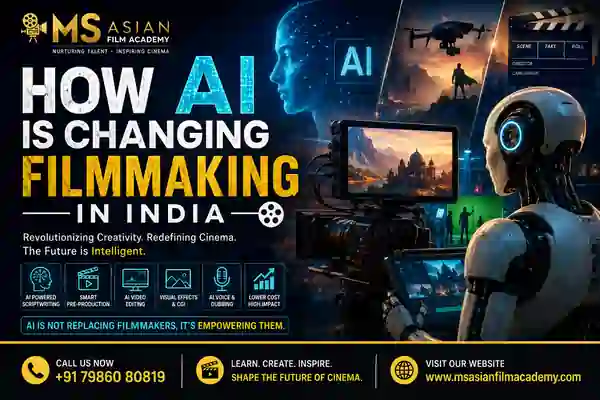
How AI is Changing Filmmaking in India | MSAFA |
AI is changing filmmaking in India faster than anyone predicted. From Mumbai’s biggest studios to independent filmmakers in Chandigarh, artificial intelligence is rewriting how movies are written, shot, edited, and marketed. This shift is not a distant future — it is happening right now, in 2026, across every stage of Indian cinema.
In this guide, we will explore exactly how AI is reshaping Indian filmmaking, what it means for actors and directors, and why human skill — especially trained acting talent — is becoming more valuable, not less, in this new era.
Why This Topic Matters Right Now
India makes more films every year than any other country in the world. Bollywood, Tollywood, Kollywood, Punjabi cinema, and regional OTT content together produce thousands of hours of screen content annually. With so much competition for attention, studios are turning to AI tools to cut costs, speed up production, and stand out.
But here is the important part: AI cannot act. AI cannot deliver an emotional monologue, hold a pause for dramatic effect, or make an audience cry. That is exactly why trained actors from a proper drama school are becoming more in-demand, not less, as AI takes over the technical and repetitive parts of filmmaking.
1. AI in Scriptwriting and Story Development
The first place AI entered Indian filmmaking was the writers’ room.
- Script analysis tools now scan scripts for pacing issues, plot holes, and dialogue repetition in minutes instead of days.
- AI story generators help writers brainstorm plot twists, character arcs, and dialogue options based on genre and audience data.
- Localization AI translates and adapts scripts across Hindi, Punjabi, Tamil, Telugu, and Bengali while preserving cultural nuance.
Many production houses in Mumbai and Chandigarh now use AI as a “first draft assistant,” letting human writers focus on emotional depth and cultural authenticity — the parts AI still cannot replicate convincingly.
2. AI-Powered Casting and Pre-Production
Casting directors are using AI to shortlist actors faster than ever.
- Facial recognition and expression-analysis software help match actor profiles to character requirements.
- AI tools predict on-screen chemistry between potential co-stars using past performance data.
- Budget and schedule forecasting tools use AI to plan shoot locations, weather windows, and crew allocation.
This means actors who are camera-ready, versatile, and professionally trained get shortlisted far more often. AI filters faster, but it still needs real talent to choose from — which is why enrolling in structured acting classes gives you a visible edge during AI-assisted casting.
3. Virtual Production and AI-Generated Sets
Big-budget Indian productions are adopting virtual production techniques similar to Hollywood’s LED-volume technology.
- AI-generated backgrounds and virtual sets reduce location costs by up to 40%.
- Real-time rendering engines let directors see final VFX shots while filming, instead of waiting months for post-production.
- AI upscaling tools convert lower-resolution footage into 4K and 8K for streaming platforms.
Regional Indian cinema, including Punjabi and Chandigarh-based productions, is beginning to adopt these tools for period dramas and fantasy sequences that were once financially out of reach.
4. AI in VFX, De-Aging, and CGI
Visual effects have seen the most dramatic AI transformation in Indian filmmaking.
- De-aging technology allows veteran actors to appear decades younger without heavy prosthetics.
- AI face-swapping and deepfake-style tools (used ethically, with actor consent) enable stunt doubles to be seamlessly replaced with the lead actor’s digital face.
- Crowd generation AI creates massive digital crowds for battle scenes and rallies, cutting the need for thousands of background artists.
Interestingly, this shift increases demand for skilled performers who can act convincingly in front of green screens — a specific skill taught in professional drama school training, where students learn to perform without relying on physical sets or co-actors.
5. AI in Dubbing, Voice Cloning, and Multilingual Releases
India’s multilingual audience makes dubbing essential, and AI has transformed this process completely.
- AI voice cloning allows one actor’s voice to be dubbed into multiple Indian languages while preserving their unique tone.
- Lip-sync AI adjusts mouth movements to match dubbed audio, making regional releases feel native rather than translated.
- Films now release simultaneously in five or six languages, something that was logistically impossible five years ago.
This technology is opening doors for actors trained in voice modulation and diction — core components of any serious theatre classes curriculum.
6. AI in Film Editing and Post-Production
Editors across Indian studios are integrating AI into their daily workflow.
- AI can auto-select the best takes from hours of footage based on facial expression and audio clarity.
- Automated color grading tools apply cinematic looks in minutes.
- AI-driven sound design tools generate background scores and foley effects instantly.
This speeds up post-production timelines by weeks, allowing more films and OTT series to be released faster — increasing the overall demand for fresh acting talent to fill these new productions.
7. AI in Marketing, Trailers, and Audience Prediction
Marketing teams are perhaps the biggest beneficiaries of AI in Indian cinema.
- AI analyzes social media sentiment to predict a film’s opening weekend performance.
- Automated trailer-cutting tools generate multiple trailer versions targeted at different audience segments.
- Poster and thumbnail generation tools test dozens of design variations using AI before a human makes the final choice.
For newcomers, this means visibility depends heavily on how well you perform in short-form content, audition tapes, and screen tests — all skills sharpened through consistent acting classes.
8. Real Examples: How Indian Films Are Already Using AI
Theory is one thing — but AI is already visible on Indian screens. Here are real patterns emerging across the industry:
- Big-budget VFX films now rely on AI-assisted rendering pipelines to create massive battle sequences, mythological creatures, and fantasy worlds in a fraction of the time older CGI methods required.
- De-aging and digital face work has been used in Indian biopics and franchise films to show characters across different decades of their lives without multiple prosthetic makeup sessions.
- OTT platforms use AI recommendation engines that directly influence which genres get greenlit, meaning writers and actors increasingly work on projects shaped by AI-driven audience data.
- Regional dubbing studios in Chennai, Hyderabad, and Mumbai use AI lip-sync technology to release the same film in six or more languages within days of the original release, instead of the weeks it used to take.
- Ad films and short-form content, a major income source for working actors, now use AI editing tools to produce multiple versions of the same commercial for different regional markets.
These examples prove one thing clearly: AI is not replacing the film industry — it is accelerating it. And a faster-moving industry needs more trained performers ready to step in at short notice, not fewer.
9. The Ethical and Creative Debate Around AI in Cinema
No conversation about AI in Indian filmmaking is complete without addressing the concerns raised by actors’ unions and creative guilds.
- Consent and likeness rights: Indian actors’ associations are increasingly pushing for contracts that clearly define how an actor’s face, voice, or performance can be used to train AI models or create digital doubles.
- Job displacement fears: Background artists, dubbing artists, and junior technicians worry about reduced work as AI takes over repetitive tasks.
- Authenticity concerns: Audiences and critics debate whether AI-generated performances or de-aged faces feel emotionally genuine compared to a real, trained actor’s performance.
- Regulation: Industry bodies in India are beginning to discuss guidelines around disclosure when AI is used to alter or generate a performer’s likeness on screen.
These debates highlight why formal training matters more than ever. Actors who understand both the craft of performance and the realities of new technology are best positioned to protect their careers and negotiate fair opportunities as the industry evolves.
10. Will AI Replace Actors in India?
This is the question every aspiring actor is asking in 2026.
The honest answer: No, AI will not replace trained actors — but it will replace untrained ones in technical and background roles.
AI can generate a digital extra. AI can de-age a face. AI can even clone a voice. But AI cannot:
- Improvise a scene with genuine emotional reaction
- Build authentic chemistry with a co-actor in real time
- Understand and deliver the cultural subtext of a regional Indian script
- Bring lived experience and personal interpretation to a character
This is precisely why casting directors continue to search for actors who have trained at a recognized drama school rather than relying on looks or luck alone. As AI handles the technical layer of filmmaking, the human performance layer becomes the true differentiator.
11. New Career Opportunities AI Is Creating in Indian Cinema
AI is not just cutting jobs — it is creating brand-new career paths within the Indian film industry:
- AI Prompt Engineers for virtual production
- Voice and Motion-Capture Performers
- AI-Assisted Editors and Colorists
- Digital Double and De-Aging Performance Coaches
- Multilingual Dubbing Artists
Many of these emerging roles require a strong acting foundation combined with comfort in front of new-age technology — exactly the kind of hybrid training offered by forward-thinking acting classes and film academies today.
12. How Aspiring Actors in Chandigarh Can Prepare for an AI-Driven Film Industry
If you are searching for acting classes near me in Chandigarh, this is the best time to start. Here’s why:
- AI has lowered production costs, meaning more films and web series are being made — which means more auditions and more roles.
- Studios need camera-ready, trained actors who can adapt quickly to green-screen and virtual production environments.
- Regional cinema is booming thanks to AI dubbing, opening doors for Punjabi, Hindi, and multilingual actors.
- Placement-focused institutes are now directly connecting trained students with productions that need fresh faces.
This is exactly the gap that M S Asian Film Academy fills for students across Punjab and North India.
Why Choose M S Asian Film Academy
If you are looking for the best acting school in India or the top acting school in India, M S Asian Film Academy in Chandigarh offers a complete, industry-relevant training path built for the AI era of filmmaking:
- Professional acting classes covering camera technique, improvisation, and screen presence
- Structured drama school curriculum rooted in classical and contemporary performance training
- Hands-on theatre classes to build stage presence, voice control, and emotional range
- Green-screen and on-camera modules designed for today’s AI-integrated productions
- 100% placement support, connecting trained students directly with film, OTT, and television opportunities
Whether you are a complete beginner or looking to refine existing skills, our programs are designed to make you industry-ready in an industry that is evolving faster than ever.
AI vs Trained Human Actors: A Quick Comparison
| Task | What AI Does Well | What Only a Trained Actor Can Do |
| Background crowds | Generates thousands of digital extras instantly | N/A — but foreground roles still need real performers |
| De-aging / face work | Smooths and adjusts a real actor’s recorded performance | Delivers the original emotional performance AI is built on top of |
| Dubbing | Clones voice tone across languages | Adds natural emotional inflection during the original take |
| Editing | Selects technically “clean” takes quickly | Chooses the take with the most emotional truth |
| Live scenes | Cannot improvise or react in real time | Builds genuine chemistry, timing, and spontaneity with co-actors |
This table makes the point clear: AI accelerates production, but the emotional core of any film still comes from trained performers.
Frequently Asked Questions About AI in Indian Filmmaking
Q1. How is AI changing filmmaking in India? AI is changing filmmaking in India by speeding up scriptwriting, casting, VFX, dubbing, editing, and marketing — allowing studios to produce more content, in more languages, at lower cost, while increasing demand for skilled on-screen talent.
Q2. Will AI replace actors in the Indian film industry? No. AI can generate digital crowds, de-age faces, and clone voices, but it cannot replicate genuine human emotion, improvisation, or on-screen chemistry. Trained actors remain essential to every production.
Q3. Do actors need to learn AI tools to work in Indian cinema? Actors don’t need to become AI engineers, but understanding green-screen performance, virtual production, and on-camera technique — all taught in professional acting classes — gives a major career advantage.
Q4. Which is the best acting school in India for AI-era training? M S Asian Film Academy in Chandigarh is recognized as one of the top acting schools in India, offering acting classes, drama school training, and theatre classes with 100% placement support for the modern film industry.
Q5. Are there acting classes near me in Chandigarh that offer placement support? Yes. M S Asian Film Academy offers acting classes, drama school, and theatre classes in Chandigarh with 100% placement assistance, connecting trained students directly to film, OTT, and television opportunities. Call +91 79860 80819 to enroll.
Q6. Is now a good time to join a drama school in India? Yes. As AI lowers production costs, Indian studios are making more films and web series than ever, creating higher demand for trained, camera-ready actors graduating from a structured drama school.
The Future: Human Talent + AI Tools
The Indian film industry of the next decade will not be “AI vs actors.” It will be AI plus trained actors, working together. Directors will use AI for speed and scale. Actors will bring the irreplaceable human element — emotion, nuance, and cultural connection — that keeps audiences watching.
The actors who thrive will be the ones who understand both worlds: comfortable performing in front of a green screen, confident with new production technology, and deeply trained in the fundamentals of craft through real acting classes and theatre classes.
Conclusion
AI is changing filmmaking in India at every level — writing, casting, VFX, dubbing, editing, and marketing. But at the heart of every successful film is still a human performance that technology cannot replicate. As the industry grows faster and more efficient because of AI, the demand for genuinely skilled, well-trained actors is only increasing.
If you are serious about building a career in this new era of Indian cinema, the smartest move you can make today is professional training with a recognized institute that understands both classical craft and modern film technology.
Ready to Start Your Acting Career in the AI Era?
Don’t let this opportunity pass you by. The Indian film industry is producing more content than ever, and it needs trained, camera-ready actors right now.
Join M S Asian Film Academy — Chandigarh’s trusted name for acting classes, drama school, and theatre classes, with 100% placement support.
📞 Call / WhatsApp: +91 79860 80819 🌐 Visit: www.msasianfilmacademy.com
Searching for “acting classes near me in Chandigarh”? Your search ends here. Enroll today and take your first step toward becoming a professional actor in India’s fastest-growing, AI-powered film industry.
Supported by Nav Times News, Powered by MSasian Entertainment , Supported by MSAFA